
Offshore bookmakers are cashing in on US college volleyball
Betting sites operating from outside the US are offering odds on NCAA women’s volleyball and streaming matches. The branding of one operator appears in explicit videos on Pornhub.
In the United States, three freshman women’s volleyball players who featured in the Penn State Nittany Lions’ recent defeat to the Tennessee Lady Volunteers on 20 September 2026 must wait a few years before they are 21 and can legally enter a casino’s gaming floor or place a bet online in the state of Pennsylvania. Play the Game has chosen not to name the players.
Even then, the National Collegiate Athletic Association (NCAA) – the governing body for more than 20 college sports, including volleyball – prohibits them from betting on any sport in which it holds a championship. This restriction applies to all NCAA athletes and athletics staff.
Yet a Play the Game investigation shows that it was possible to place bets on their performances in that game, just as it is possible to place bets on almost all other games taking place during the NCAA women’s volleyball regular season.
Regular season matches like Penn State’s feed into the country’s most prominent volleyball competition, the NCAA Division I Women’s Volleyball Championship. The 64-team knockout bracket will be revealed on 29 November, and the final will be played in San Antonio, Texas, on 20 December 2026.
Far more popular in the US than its male equivalent, the women’s game has boomed in recent years. Network television now broadcasts the latter stages of the NCAA tournament, participation has grown by 16% over the past decade, and attendance records are regularly broken.
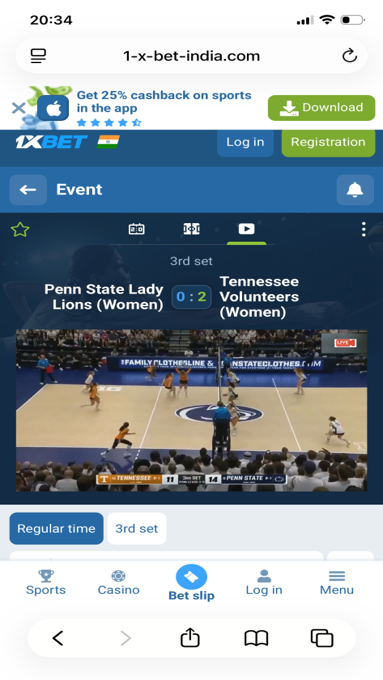
Penn State’s defeat to Tennessee on 20 September, livestreamed on a 1xBet-branded betting site. The footage carries the TV broadcast’s own score graphics, while the site offers live betting on the match. Screenshot: 1xBet website
Not all of the impact of this increased popularity has been positive; far from it. Matches featuring women as young as 18 are streamed without authorisation by multiple illegal* offshore bookmakers operating beyond the US border. Those websites are theoretically blocked in the US, but accessing them from Memphis or Philadelphia is child’s play: all it takes is a Virtual Private Network (VPN).
“The exploitation of college sports by illegal betting operators highlights a fundamental failure of accountability,” says Brandie E. Black, co-founder of ESG iGaming, which advises betting companies on sustainable and ethical business practices. “Sporting events, athlete data, and live broadcasts should not become commercial assets for operators who avoid meaningful oversight, transparency, and integrity standards.”
Black emphasises that the integrity of sport depends on more than what happens on the court. “It requires effective governance across the wider betting ecosystem, including mechanisms to identify and report suspicious betting activity,” she adds. “From an ESG [environmental, social and governance] perspective, this is both a governance and social responsibility issue.”
Links to the porn industry
Platforms offering these games include 1win, a Russia-linked gambling operation, which operates websites using either a licence from Curaçao or with no licence at all. But it is another 1win promotional vehicle that stands out: pornographic films published via the Pornhub accounts of adult film actresses. The films feature the 1win brand, either on merchandise seen in the films or in watermarks. Some of them even offer promotional codes.

Image to the left: An NCAA men’s volleyball match between UC Irvine and Penn State, broadcast on the betting site 1win alongside live scores and betting. Screenshot: 1win website
Image to the right: A video on Pornhub in which the performer wears 1win-branded clothing. Screenshot: Pornhub website
“[The players’] likeness is being monetised within an ecosystem built on affiliate traffic from pornography, with no revenue, no protection and no recourse for them,” said financial crime prevention and match-fixing expert Chris Kronow Rasmussen, who serves as adjunct lecturer at the University of New Haven.
“Women’s college sport has worked hard to build a safe, credible commercial profile,” Rasmussen added. “Having it repackaged this way is a reputational and welfare harm, even if not a single bet is ever corrupted.”
Across a single weekend monitored as part of this project, 1win offered over 50 NCAA women’s volleyball games for live and prop betting – those wagers on specific events within a match rather than on the result. They involved the Nittany Lions as well as other major US university teams, such as the Stanford Cardinal, the Yale Bulldogs, and the University of Texas Longhorns.
Volleyball is prominently featured in 1win’s sportsbook marketing. During a single monitored weekend, the offshore betting operator offered wagers on more than 50 NCAA women's volleyball matches. The 1win brand has also appeared in pornographic videos published on Pornhub. Screenshot: 1win website
1win is not the only offshore operator offering these games, nor the only one linked to the porn industry. 1xBet, founded in Russia and headquartered in Cyprus, was forced out of the British market in 2019 after a Sunday Times investigation revealed it was promoting a “Pornhub casino” and taking bets on children’s sport.
1xBet is banned, restricted and/or blacklisted in many countries around the world, from the US to Morocco to Colombia. The company has its own connection to the porn industry: Eva Elfie, a well-known adult star, has worked as one of its star ambassadors.
Other offshore operators offering NCAA volleyball games include Leonbet, Winline, 22Bet and Mostbet, which also advertises on porn sites.
Image to the left: A volleyball match in the US streamed on a 22Bet-branded betting site, with live betting markets shown below the video. Screenshot: 22Bet website
Image to the right: Mostbet offering odds on a college volleyball match between Purdue Fort Wayne and Loyola Chicago in April 2026. Screenshot: Mostbet website
Integrity concerns
Our team reached out to around 40 colleges whose games have been livestreamed on the offshore market, contacting both the colleges’ communications teams and their volleyball coaching staff. Only three of them responded: Benedict, Fairleigh Dickinson, and Purdue Fort Wayne. None were aware that it was possible to place bets on their matches, or to watch their athletes on the offshore betting platforms. We asked whether this troubled them.
While “No” was the laconic reply we received from Benedict College’s Tigers, a representative of Purdue University Fort Wayne’s volleyball sides expressed unease. “The unauthorised use of live video of Mastodon athletic events on betting platforms is a matter of concern,” they said.
Senior sports integrity officials back this up. Speaking on condition of anonymity, two of them told Play the Game that it is unheard of for bookies licensed in places like Curaçao to issue suspicious betting alerts – the warnings that flag the possibility of a fixed game so that authorities can investigate. Without them, a fixed match is more likely to go unnoticed.
The same officials added that for a properly regulated bookmaker, such alerts should be a non-negotiable condition of their right to operate. In other words, offshore bookies are a threat to the integrity of the very sports they offer for betting.
In April 2026, independent bet monitoring consultant Francesco Baranca spotted suspicious betting on two NCAA women’s games. It was the first time he had come across issues in college-level volleyball.
“The integrity problem has now reached into academic sport,” says Baranca, who has observed huge growth in betting on college sports since the outbreak of the Covid-19 pandemic and believes these markets operate without proper guardrails. “Competitions designed for students, with no professional stakes, and minimal institutional oversight, are being offered as betting products and are already attracting the attention of manipulation networks.”
“This is not where the problem ends. It is where a new front is opening.”
A women’s college volleyball match between Nebraska and Stanford in August 2025. Stanford is among the universities whose matches have been offered by offshore betting operators. Photo: Steven Branscombe/Getty Images
Where does the data come from?
To offer live betting on matches like these, bookies first need a fast, reliable flow of real-time data, so they can monitor every second of the match and set their odds accordingly. This requires a systematic, highly sophisticated capture of in-play data. Some go further and offer live streaming of the matches too.
“A book offering in-play betting needs to know what is happening on court in near real time,” said Rasmussen. “Hijacking a school’s own stream gives them a product they have no right to, at zero cost, with no data licence, and no integrity partner attached.”
He added: “It also tells you these are not marginal operations. Someone is systematically finding, capturing, and re-broadcasting US college fixtures at scale.”
But the source of 1win’s data is unclear.
Cognisant of ongoing problems being caused by prop bets in other sports, the NCAA has restrictions on who can access its official data. It told Play the Game that, for regular-season matches, those restrictions are so tight that no betting operator has ever agreed to them. “Therefore, the NCAA has not provided its official data to any sportsbook,” it said in a statement. “Where betting markets exist, they are based on unofficial NCAA data.”
For NCAA championship tournaments – the competitions held after the regular season to decide national titles – Genius Sports holds exclusive rights to supply official data to licensed bookmakers, including in volleyball. The data collection and integrity monitoring company also provides colleges with software to collect real-time match data. It told Play the Game that neither 1win nor 1xBet was a customer.
The code behind 1win’s website, meanwhile, obscures the source of its data. Publicly available information suggests connections with an Israeli outfit called LSports.
The company’s website claimed that NCAA women’s volleyball “is the most requested volleyball league among LSports clients,” and is part of a huge portfolio of games it offers its clients, covering everything from “major league to niche amateur leagues.” It called volleyball one of the “fastest-growing sports” in betting. Its Polish subsidiary, STATSCORE, also offers live data from NCAA volleyball matches.
LSports also described 1win as a client. “1win chose LSports to transform its sportsbook capabilities and future-proof its operations,” it wrote in a 2025 promotional piece about its relationship with the bookie. A 1win product manager was quoted as saying the partnership was “a game-changer for 1win. Their real-time, customizable data feeds and unmatched support have allowed us to scale rapidly, expand our sportsbook coverage, and deliver a superior betting experience to our clients worldwide.”
In June 2025, LSports publicly promoted its partnership with 1Win, highlighting how its real-time sports data services supported the betting operator. Whether the partnership included data from the NCAA volleyball matches examined by Play the Game remains unclear. Screenshot: LSports website
Play the Game could not establish whether that relationship included supplying data or video for the NCAA matches examined, or how LSports could be accessing the games to capture the data.
In a separate legal dispute launched earlier this year, Sportradar – a data collection and distribution company – accused LSports of unlawfully using its content. The claim lodged with the Israeli district court in Be’er Sheva describes systematic scraping, unauthorised exploitation, and pirated distribution of Sportradar’s live sports data and audio-visual (AV) broadcast feeds. LSports has publicly denied the allegations. Playtech, a shareholder in LSports, reported that Sportradar withdrew the copyright-infringement claim on 25 June 2026; the disclosure continued to describe other claims.
“Unauthorized third parties may attempt to collect data through independent or unofficial means,” the NCAA said, speaking generally, and not in relation to LSports or the Sportradar case. “These activities are not sanctioned by the NCAA and fall outside of its authorized data ecosystem.”
LSports, which claims 1xBet and Fonbet as clients, said on its website that with its “network of 1,000 trained scouts plus advanced technology, it captures every key incident from venues and low-latency TV feeds – keeping your platform ahead of the game.” Whether those scouts are inside venues or watching TV feeds of the NCAA volleyball matches is unclear, as LSports did not respond to questions for this article.

LSports’ website told prospective clients that NCAA women’s volleyball was “the most requested volleyball league” among its customers. The page has since been redesigned. Screenshot: LSports website

1xBet among the sportsbooks LSports listed on its website as clients. Screenshot: LSports website
Unauthorised livestreams
Some offshore bookies offering these games provide a livestream of the action, sometimes using feeds from ESPN. Livestreams are a key way of keeping customers engaged and gambling. But while sports usually charge top dollar for broadcast and streaming rights, bookies offer viewers access for free.
Matthew Wein, a national security and cybersecurity expert and former policy adviser to the US Department of Homeland Security, told Play the Game: “The non-sanctioned use of television feeds for illegal gambling on American amateur sports opens athletes up to further targeting and harassment online from losing gamblers, especially given the prospect that those platforms may not pay out winnings given their place in the grey or black market.”
“There are clearly integrity concerns that go along with those threats,” he added. “The NCAA should try to work in tandem with federal law enforcement, including the Federal Bureau of Investigation (FBI) and Homeland Security Investigations (HSI), to use available authorities, in concert with their international partners, to stop these practices.”
Several universities were not aware that their games were available for betting, let alone being livestreamed, until they were contacted for this investigation. Purdue University Fort Wayne was stumped about how those streams got there, as its games are only recorded for scouting purposes. “These streams are not broadcast live online and are not shared with sportsbooks,” it said.
The NCAA is equally concerned. “Any such use of the video feed by a sportsbook would require explicit authorization, which is not a standard component of college media rights agreements,” it told us. “The NCAA is not aware of any such video distribution or licensing agreements between a member school/conference and a sportsbook.”
Colleges, too, say the problem is out of their hands.
A representative of Fairleigh Dickinson University (FDU), whose men’s volleyball games were streamed by 1xBet, said such streams sat outside the exclusive arrangement that was in place between its conference and NEC Front Row, a US sports streaming service. “Any further distribution of the broadcast happens outside of FDU’s control,” it said. Likewise, “any wagering on FDU’s athletic contests occurs outside of our control.”
The NCAA said it is “generally aware” that its volleyball is of interest to the unregulated and illegal betting markets, which it described as an industry-wide issue. These markets, it said, rely on unofficial data, scraping technology, in-venue collection, or other unauthorised means. “The NCAA does not authorize, support, or have any formal relationship with illegal betting operators, and the presence of its events on such platforms occurs outside of its control,” it said.
“This is particularly important from the standpoint of game integrity, student-athlete welfare, and the protection of NCAA intellectual property.”
Yet gaps in oversight remain. These matches are played by students and streamed by offshore operators – many of them unlicensed in the United States. Limited visibility into those betting markets can make suspicious activity harder to detect, leaving young athletes and the integrity of their matches exposed.
* Illegal as defined by the Macolin Convention and accepted by the World Lottery Association.
The project was supported by a grant from the US Fund for Investigative Journalism.


