
The hidden pipeline linking illegal betting to the world of football
A network of agents, data firms and marketing agencies helps illegal operators secure partnerships with football clubs and federations while keeping their ownership and finances hidden.
Every industry insider contacted by Play the Game told the same story: setting up a sports betting online platform, legal or not, is child's play. "You can build a fully functional website and have it up and running in a matter of weeks", to quote one of them.
Obtaining an offshore licence is cheap and easy. Licensing agents like Fast Offshore will also set up shell companies and provide access to the global financial system for their clients via banks domiciled in offshore havens, with the Caribbean a destination of choice.
Live, in-play data can be obtained from companies which double up as integrity monitors, either directly or through third parties. The price of the data packages will be commensurate to the number of events on offer.
Last, the tech infrastructure needed to operate the apps and websites can be purchased wholesale "off the shelf" from the specialised B2B companies which attend industry conferences in their droves. The prices will vary a great deal, starting at under 10,000 euros for the most basic plug-and-play "minimal viable product" (MVP) to half a million euros and more for sophisticated, made-to-measure models.
All that the would-be illegal sports betting operator has to do to get their business off the ground is to follow a well-trodden, clearly signposted path, with professional assistance available at every step of the way. But then comes the greatest challenge: to build a customer base.
How is it possible to stand out in a clogged-up market when you are an illegal operator, competing against thousands of others? And how can you establish your brand without exposing yourself to unwanted attention from regulators and law enforcement agencies?
This is even more of a conundrum for Asian-facing operators who target markets in which direct advertising for gambling is strictly prohibited and even criminalised, as in Japan, for example.
An increasing number of the most visible unlicensed operators, such as BK8 in Malaysia or 1Xbet, Dafabet and Wolf777 in South Asia, have opted to test local laws and regulations by promoting "news services" which bear their names and their logos and sponsor prestigious events such as MotoGP races and test cricket.
This tactic is also used in Europe by fully licensed operators to circumvent local advertising bans. In Belgium, Club Brugge signed a three-year sponsorship deal with the Betsson Group in June 2025. Club Brugge's jerseys will be emblazoned with BetFIRST.sport and Betsson.sport until the end of the 2027-2028 season, as both are considered "live score apps", not betting websites.
However, this strategy requires considerable resources and comes with a level of exposure which may well backfire once the authorities decide to fight back.
There is a much simpler (and cheaper) way to reach potential customers: direct partnerships with sports clubs and federations, football clubs and federations in particular.
Depending on the terms of the contract, those football partners might agree to display the operators' brands on their websites and in their stadiums, either on the club's jerseys or on perimeter boards.
Football partners can also lend their players to feature in advertisements for the brands in question. Asian-facing companies are particularly fond of posting videos of well-known footballers wishing their customers a Happy New Year or a Happy Autumn Festival, for example. This is how members of the Belgian men's national football team found themselves speaking Mandarin for the benefit of KOK Sports.
Figure 1: The middleman system in illegal betting
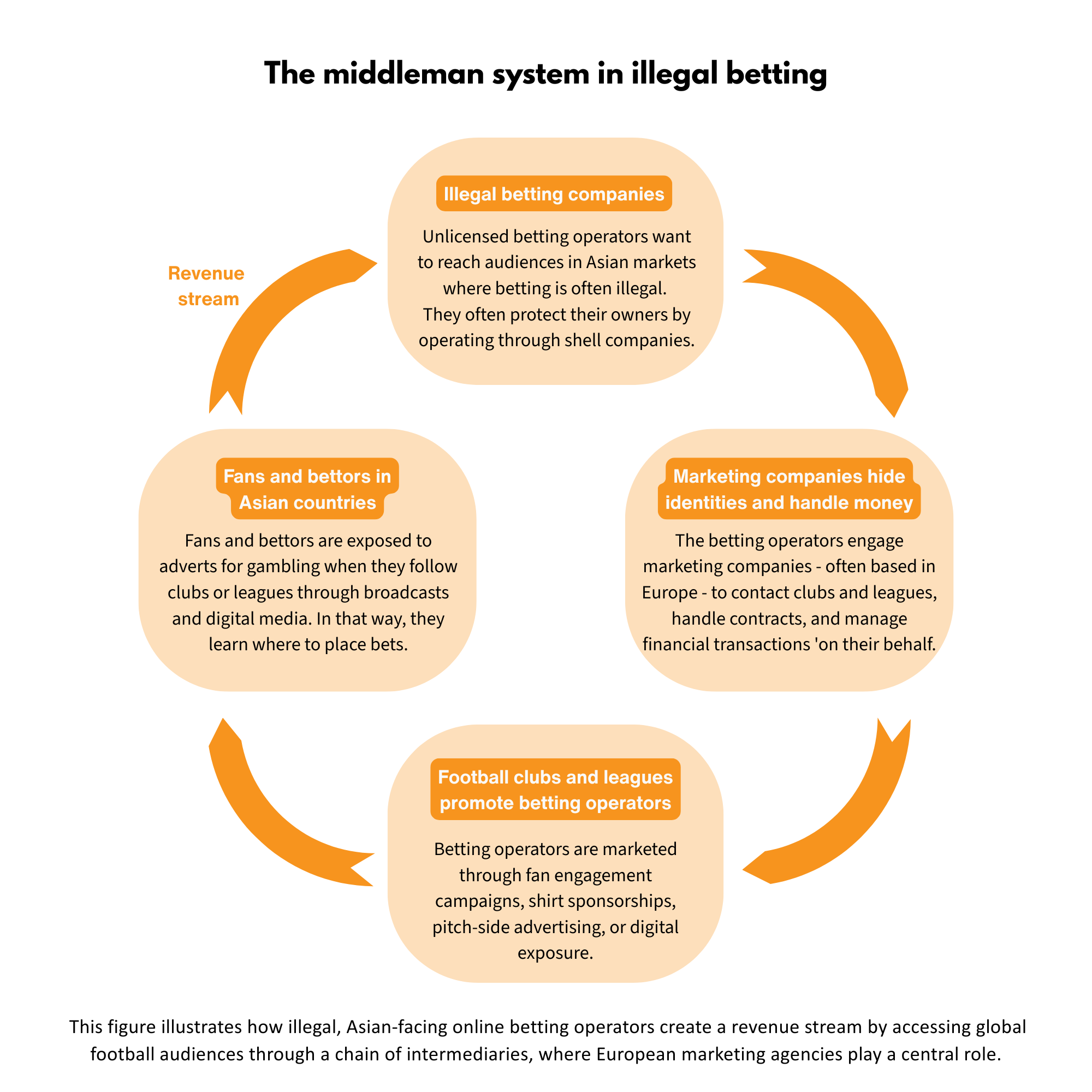
This figure illustrates how illegal, Asian-facing online betting operators create a revenue stream by accessing global football audiences through a chain of intermediaries, where European marketing agencies play a central role.
At least 142 partnerships between clubs and illegal betting operators
For more than five years, Play the Game has monitored illegal sports betting websites, industry newsletters and club statements to build a database, and it shows that at least 142 different illegal Asian-facing operators have teamed up with top-level football clubs and national teams since Tottenham Hotspur became the very first European club to do so.
That happened in May 2006, when the Mansion group, also known as MansionBet and M88, became their front-of-shirt sponsor for four seasons, for a then-record 34 million pounds sterling.
Moreover, most of these operators have partnered with multiple clubs. A new record of active partnerships has been set by 8Xbet in the 2025-26 season, with no fewer than nine English football clubs promoting their brand in the Premier League and the Championship, namely Bournemouth, Chelsea, Crystal Palace, Ipswich Town, Leeds United, Leicester City, Newcastle United, Nottingham Forest and Sunderland.
Figure 2: Number of clubs with partnership deals in place with illegal Asian-facing operators, 2025-26 season
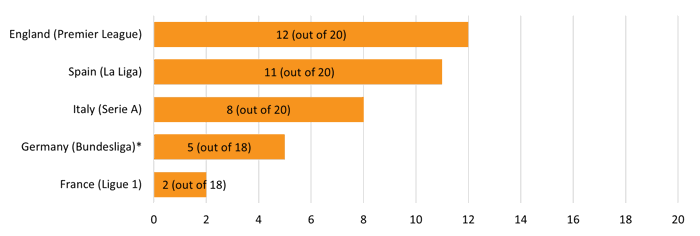
The figure shows the number of clubs in the big five leagues which have partnership deals in place with illegal Asian-facing operators in the 2025-26 season. Several Spanish, English and Italian clubs have multiple partnerships in place. The figure does not include partnerships between "Big 5" football clubs and illegal operators which do not target the Asian market. All figures are based on open-source information gathered by Play the Game, valid as of 26 March 2026. * Includes MCW deal with the Bundesliga.
Figure 3: Number of illegal Asian-facing operators with partnership deals in place with football clubs in the big five leagues, per league, 2025-26 season
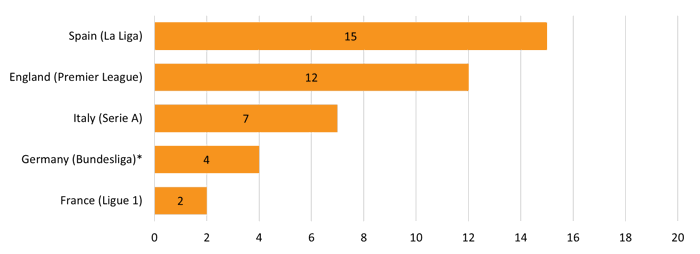
The figure shows the number of illegal Asian-facing operators with partnership deals in place with "Big 5" football clubs, per league, in the 2025-26 season. Several operators have partnerships in place with multiple clubs. The figure does not include partnerships between "Big 5" football clubs and illegal operators which do not target the Asian market. All figures are based on open-source information gathered by Play the Game, valid as of 26 March 2026. * Includes MCW deal with the Bundesliga.
A system of brokers works behind the scenes
But how can illegal operators who are paranoid about disguising their identity enter into partnerships of this kind without revealing who they are? And how can clubs and FAs willingly sign commercial deals with entities which may be linked to human trafficking, cyber slavery and the criminal underworld?
This is when another type of enabler steps in: the go-betweens.
Astonishing as it may sound, in 2026, football clubs and sports agents domiciled in the European Union are not subject to the Anti-Money Laundering (AML) regulations most other businesses - and private citizens - have to comply with. This is an anomaly which will not be addressed until 2029, and then, only on a partial and progressive basis.
That said, clubs and agents are still expected to exercise caution when engaging with new commercial partners and to stick to some basic rules and due diligence processes.
These include knowing the source of the funds received and the names of the ultimate beneficial owners (UBOs) of the entities concerned, as the Great Britain Gambling Commission reminded several Premier League clubs in May 2025. This is in theory, as in practice, none of the clubs and federations will know either. Everything is done to disguise both.
One reason is that, in almost all cases, the signatory of the agreement on the betting operator's behalf will be a shell company set up for that purpose, whose own ownership structure is untraceable. The other is that, more often than not, the transaction will have been brokered by an intermediary.

Premier League club, Bournemouth, was warned by the Great Britain Gambling Commission in 2025 that the club riskedprosecution if they promote unlicensed gambling businesses that transact with consumers in Great Britain such as shirt sponsor bj88. Photo: Catherine Ivill / Getty Images
The intermediaries who facilitate or broker partnership deals between sports betting operators and football clubs or federations fall into four broad categories.
1) Individuals who act as independent agents. Their role will be limited to establishing contact between the parties. They will have no contractual relationship in place other than an ad hoc agreement.
Play the Game understands that three summers ago, one such (British) agent, known for his contacts within French football, was asked by a marketing agency to approach several Ligue 1 clubs to offer them deals with an Asian-facing illegal operator worth 500,000 euros each per season. One of the clubs alerted the French regulator, who put an end to the discussions.
2) Data collection agencies/integrity monitors, which double up as data providers for the gaming industry. They will use their connections in the sports world and the gambling industry to broker deals for which they will be paid a commission.
An example of this is the deal passed in 2023 (and renewed in 2025) between the Bundesliga and Mega Casino World (MCW), an illegal online platform which operates solely in Asia. Data collection agency Sportradar, the integrity partner of over 150 sports leagues and governing bodies (including UEFA, Fifa and NBA), "negotiated" the deal in partnership with Bundesliga International.
MCW is also a current partner of La Liga club Atlético de Madrid.
3) Specialist agencies which cater to the sports world in general but have developed a special line in brokering deals between European football clubs and Asian-facing betting brands.
The specialist agencies include:
Arowana Sports, Spain, who brokered the deal between Real Madrid and illegal platform KOK Sport and claim Kaiyun, a brand linked to the criminal Yabo organisation, as one of their clients.
Outlast Sports & Entertainment, Singapore, who have acted on behalf of betting brands like BK8 and Mansion88.
MIC Advertising & Branding, Dubai, who brokered at least eight deals between elite European clubs, including Juventus, Atlético de Madrid, Leicester City and Borussia Mönchengladbach, and illegal Asian bookmakers since 2022.
Sportquake, England and China, the doyen of that group of agencies, founded by Matt House in 2006, the year Mr House left his position as director of commercial partnerships at Premier League club Tottenham Hotspur. Uniquely, SportQuake opened offices in Hong Kong and Beijing in 2016.
Pitch International, England, whose latest deal teamed up Premier League club Burnley FC with 96.com.
In 2025, Pitch International announced on LinkedIn that it had brokered a deal between Burnley Football Club and its international betting client, 96.com.
4) Multinational sports marketing and broadcasting rights agencies, of which SPORTFIVE, formerly Lagardère Sports, is the undisputed market leader.
SPORTFIVE is particularly active in Germany, where it has brokered at least six deals on behalf of illegal operators, with five Bundesliga clubs: FC Augbsurg, Hertha BSC, Hamburg, Bayer Leverkusen and, twice, Borussia Dortmund.
Current Borussia Dortmund CEO Carsten Cramer, who oversees all sponsorship deals for the club, worked for SPORTFIVE from 2002 to 2010.
TGI Sport, which is controlled by Bruin Capital, is the other European giant, especially since its acquisition of Interregional Sports Group (ISG) in September 2022.
The group now dominates the European market of in-stadium advertising and is recognised as the undisputed leader in virtual advertising boards technology, with a market share of 80% worldwide.
This digital technology makes it possible to choose which brands are advertised on LED perimeter boards according to the countries where the matches are broadcast.
Viewers in the Far East who are watching a La Liga game may see advertising for illegal Asian-facing bookmakers, while spectators in Spain, both those present in the ground and those watching on TV, will see something else, as all gambling advertising in sports events is prohibited there.
Play The Game has also identified five partnership deals between illegal operators and football clubs or leagues which were brokered by ISG.
From openly brokered deals to partnerships in the shadows
Such partnership deals are now most often shrouded in secrecy. It wasn't always thus.
In the 2010s, SportQuake carved itself a niche as the go-to intermediary for Asian-facing operators and football clubs, especially English football clubs, wishing to do business together, to such an extent that the agency was said to be responsible for over half of the front-of-shirt sponsorships of Premier League clubs in 2017.
SportQuake was not shy of its success in this field and published a document which listed its achievements. This document, seen by Play the Game, has now been taken offline, and none of the partnerships it listed appears on the agency's website anymore.
However, the parterships were: FUN88-Newcastle, ManBetX-Crystal Palace, Lovebet-Burnley, M88-Bournemouth, toutou-Werder Bremen, 12BET-West Bromwich Albion, FUN88-Tottenham, Lovebet-PSG, d3.com-Atlético de Madrid, ZS98-Borussia Mönchengladbach and BCKBet/Yabo-Serie A.
More recently, only a couple of years ago, "Vice President Borussia Dortmund Global Partnerships @ SPORTFIVE" Jonathan Webster appeared in person in the staged "signing ceremony" which marked the beginning of Borussia Dortmund's relationship with illegal operator XingKong.
Mr. Webster even delivered the keynote speech, celebrating a partnership which "closely matched [Borussia Dortmund's] international values".
Borussia Dortmund announced its relationship with illegal operator XingKong in a video shared on Youtube.
Details of the nature of these partnership agreements are even more difficult to come by, with financial details now kept confidential. However, Play the Game has had access to a couple of such contracts.
One case was a 1.5 million USD per season contract between a well-known Asian-facing illegal sports betting company (and current Premier League club sponsor) and a national football federation. The identity of both parties was withheld in order to protect the source who passed on the document to Play the Game.
The other case was between the African Football Confederation (CAF), the Russian-Cypriot platform 1XBet and the sports marketing agency Lagardère Sports & Entertainment, which was rebranded as SPORTFIVE after coming under the control of US "alternative investment firm" HIG Capital in the spring of 2020.
In the first case, it was impossible to ascertain whom that federation had concluded an agreement with. Though the operator was named in the contract, the only corporate particulars, including bank details, referred to the Asian marketing agency which had put the parties in touch.
In the second case, the name of the actual brand, 1XBet, did not appear once in the 35-page contract. The agreement (which runs until 2028) was signed on behalf of the bookmaker by one Anastasia Ioannidou, the representative of a Seychelles-based shell company called Go Tech Development Ltd, here acting as a screen for the actual owners of the company, believed to be a trio of fugitives who fled Russia in the late 2010s.
An "Anastasia Ioannidou" also appears in corporate information relative to the Nigerian iteration of 1XBet, 1xbet.ng, as the registrant of its domain name via another Seychelles company called Best Buy Solution Corp., which is registered at the same address as Go Tech Development Ltd: Gateway 8, Rue de la Perle, Mahé. Ioannidou also registered the melbet.com.ph domain name via Best Buy Solution Corp on behalf of 1Xbet's sister brand, Melbet.
The most striking aspect of the document is that the signatory on behalf of the African Football Confederation CAF was not CAF itself, but its marketing partner, Lagardère Sport.
CAF did not actually discuss matters directly with its betting sponsor; everything went through the marketing rights-holder, including the money due to the confederation, which would be paid in the French bank accounts of the marketing agency.
Sources from within the football and marketing worlds told Play the Game that this was standard practice when partnerships were brokered by global agencies such as SPORTFIVE or the Inter-regional Sports Group (ISG).
Clubs, leagues and federations will sign off their marketing rights en bloc to those agencies (just as they can sign off their broadcasting rights to the same companies), whose role it is then to exploit them. The transaction can be fee- or commission-based, or a mix of the two.
But what makes business sense presents significant risks in terms of corporate transparency and responsibility. It also presents an opportunity for illegal gambling partners who wish to retain their particulars hidden from the general public - and the law.
The marketing agencies act as a buffer and will fall back on their duty to abide by "commercial confidentiality" to bat inconvenient questions away, as they all did when approached by Play the Game.
The circle is then closed. Asian-facing illegal betting operators can flout regulations and flourish in the knowledge that help is at hand, but not at home. The enablers are elsewhere, mostly in Europe.
Illegal sports betting is not just "an Asian problem". It is a global problem to which there can only be a global solution, which confronts not just the operators, but their enablers too.
No replies to questions from Play the Game
Play the Game sent separate emails to five SPORTFIVE executives (including Jonathan Webster) involved in setting up partnerships with gambling operators on three occasions, in October, November and December 2025.
We asked a number of questions including: How do you typically connect sports organisations with potential [betting] sponsors? Which criteria you apply when selecting partners? And how do you assess risks and ensure that partnerships comply with legal and ethical standards?
None of them replied to our enquiries.
Play The Game also repeatedly wrote to Pitch, Outlast, ISG and SportQuake agencies. None of them responded to our emails.
Of the nine Premier League and La Liga clubs we contacted, only Athletic Bilbao responded, mainly to say: "in answer to your inquiry, [...] we cannot answer your questions as they ask for confidential information about our way of negotiating".
When Play the Game reformulated its questions, removing all references to specific betting partners, the club's spokesperson replied: "I am very sorry, but we cannot give this information".
Crystal Palace, Norwich City, Aston Villa, Burnley FC (Premier League and Championship), Elche, Valencia CF and RCD Mallorca (La Liga) declined to reply, while Huddersfield Town told us that all the personnel involved with their 2021 deal with BK8 had left the club and that they were therefore no longer in a position to provide us with answers.
This series of articles uses the definition of "illegal sports betting" which is given in Article 3, 5.a., of the 2014 Macolin Convention: "illegal sports betting” means any sports betting activity whose type or operator is not allowed under the applicable law of the jurisdiction where the consumer is located".
This definition is also accepted by the World Lotteries Association (WLA).


