
Stop betting on kids
Suspicious betting activity on youth competitions has risen sharply in recent years. Corentin Segalen and Samuel Wahlberg argue that betting on under-18 sport must be banned worldwide - and that operators, data providers, and regulators must be held accountable.
Opinions on playthegame.org reflect the views of the author(s).
In August 2025, offshore betting platforms offered odds on games from the Little League World Series, an annual baseball tournament for children aged 10 to 12. The response from Little League Baseball was unequivocal: betting on children is unacceptable.
And yet, it is happening. And it is growing.
Despite clear prohibitions in regulated markets, illegal operators continue to exploit youth competitions. What was once unthinkable is quietly becoming normalised. The consequences are profound: the integrity of sport is at risk, and so is the well-being of young athletes.
A surge in manipulation of youth competitions
The data is alarming. According to the Group of Copenhagen’s Logbook – which compiles reports submitted by the international network of national platforms together with alerts from United Lotteries for Integrity in Sports (ULIS) – cases of suspicious betting activity involving youth competitions have risen sharply in recent years. From just 21 alerts concerning under-18 matches in 2021, the figure reached 160 in 2025, an eightfold increase in the space of four years.
This phenomenon is not confined to a single region. Countries affected include Argentina, Australia, Brazil, Malaysia, Myanmar, Russia, United States and Vietnam. Football accounts for the overwhelming majority of cases (98%), but other sports – including basketball, volleyball, ice hockey, and baseball – are also affected.
The most commonly targeted betting markets include match winners (114 cases), over/under totals (72 cases), and Asian handicap betting (53 cases), that can be mixed for some matches. This is not random. It is systematic exploitation by criminals.
Why is this happening?
Several dynamics are converging to drive this trend.
What is most immediately visible is the growing normalisation of sports betting among young people. Through social media, influencers and widespread exposure to betting content, the boundary between participating in sport and gambling on it has become increasingly blurred. For many, betting is no longer perceived as external to the game, but as part of its environment.
This normalisation intersects with a deeper vulnerability. Young athletes, particularly those under 25, are more exposed to risks of addiction, impulsive behaviour and financial pressure, while often lacking awareness of integrity rules and consequences. This makes them easier targets for manipulation.
These vulnerabilities are actively exploited by illegal operators. Free from effective oversight and age verification requirements, such platforms can offer betting markets on youth competitions with little constraint, creating conditions that are especially conducive to abuse.
At a more structural level, the role of betting data providers should not be overlooked. The collection and commercialisation of data from youth competitions – sometimes without adequate safeguards – contributes to making these events visible, tradable and ultimately exploitable within betting markets.
Finally, these developments persist because governance frameworks have not kept pace. Regulatory approaches remain fragmented, enforcement uneven, and international coordination limited. In the absence of clear and consistently applied rules, a space has emerged in which betting on youth competitions can continue to develop.
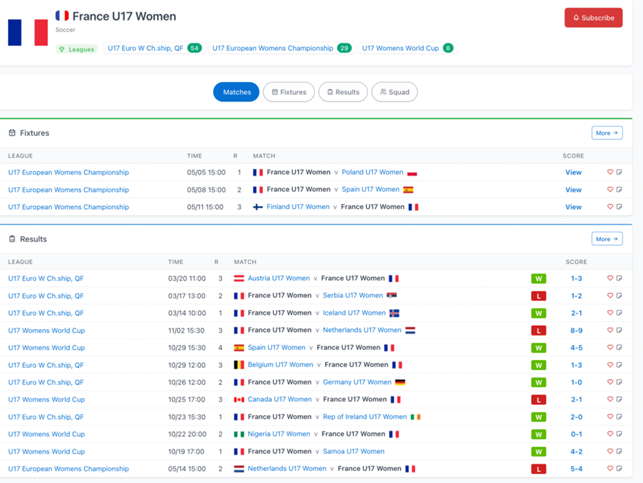
Screenshot from API aggregating service, listing France U17 women matches which have either been offered or will be offered on betting markets.
Time to Act
Protecting young athletes now requires clear, coordinated and immediate action.
First, a principled position must be established: competitions for those under the age of 18 should not be open to betting, under any circumstances. This implies a comprehensive prohibition, irrespective of the sport or the level of competition. These principles must be anchored in law. All national legislations should explicitly prohibit betting on youth competitions, and provide for effective enforcement, including sanctions targeting not only operators, but also intermediaries and data providers.
Second, name and shame the operators that continue to offer bets on youth competitions. Bringing these practices to light is an essential step in discouraging them. Operators offering bets on U18 competitions should be immediately listed as high-risk by the Council of Europe’s Macolin Convention.
Third, the role of data providers must be addressed more rigorously. As long as data from youth competitions can be collected, commercialised and circulated, betting markets will continue to find ways to emerge. Sports organisations therefore have a responsibility to act at the source by systematically including, in their contracts with data providers, explicit prohibitions on the use of such data for betting purposes on under-18 competitions. These clauses should be backed by effective enforcement mechanisms, including financial penalties and, where necessary, the termination of contracts in cases of non-compliance.

Corentin Segalen (l) is the coordinator of the French National Platform against sports manipulation and Samuel Wahlberg (r), the coordinator of the Swedish National Platform against match-fixing, chairs the Group of Copenhagen. Photo: Philippe Auclair
Finally, integrity actors themselves must take a clear and unified position. Organisations and networks involved in safeguarding sports integrity should commit, formally and collectively, to excluding any form of betting on competitions involving minors, whether direct or indirect. This is precisely the aim of this tribune: to call for a coordinated, uncompromising stance that protects young athletes and reinforces the ethical foundations of sport.
We call on sports organizations, responsible sports betting operators, public authorities, and legislators worldwide to mobilise. The time has come for all nations to adopt Article 9.1(b) of the Macolin Convention, which explicitly excludes competitions “which are designed for individuals under the age of 18”. Stop betting on youth sports is not optional – every day we delay, we put a generation at risk.
This piece was first published at the investigative site Josimar.
Samuel Wahlberg is the coordinator of the Swedish National Platform against match-fixing and the current president of the Network of National Platforms (Group of Copenhagen), the advisory group of the Macolin Convention’s Follow-up Committee.
Corentin Segalen is the coordinator of the French National Platform against sports manipulation and was president of the Group of Copenhagen from 2021 to 2025 . He coordinated the monitoring of sports manipulation during the Paris 2024 Olympic Games.


