
FIFA’s betting expansion raises integrity fears ahead of the 2026 World Cup
FIFA’s growing ties to betting operators, prediction markets, and data companies are opening new integrity risks from the World Cup to low-level matches streamed on FIFA+. Experts warn that football’s global body is commercialising betting opportunities faster than it can police them.
Listen to a narrated version of the article in your podcast app of choice
Since striking a deal with betting operator Betano shortly before the 2022 FIFA World Cup in Qatar, FIFA’s relationship with the betting industry has ballooned to such a scale that integrity concerns are growing at an equal rate.
The year after the Betano deal, FIFA signed up New Zealand lottery TAB for the Women’s World Cup, the Betano deal was renewed for the 2025 FIFA Club World Cup and in early 2026, FIFA commercialised its streaming platform FIFA+ through a deal with data company Stats Perform, bringing more low-level games onto betting markets.
FIFA then embraced prediction markets through a deal with brand-new operator ADI Predictstreet. The agreement was quickly scrutinised by investigative site Josimar, which raised a series of concerns about the company, including the absence of a functioning website, a Gibraltar licence reportedly granted in just nine days at the discretion of Gibraltar’s minister of finance, and links to Abu Dhabi’s royal family.
On the eve of a World Cup in North America offering a range of other problems for FIFA, the prediction markets boom is emerging as the highest profile of a number of integrity threats facing FIFA as it deepens its relationship with the betting industry.
Prediction markets raise new risks for sport
Prediction markets operate like an exchange. A punter proposes a binary outcome, such as Ecuador winning the World Cup. Other customers either back or oppose that proposition and create a ‘market’. The operator then takes a cut of this market without facing any discernible risk as a traditional betting operator.
Most discussions on prediction markets are dominated by two behemoths. Kalshi, which is predominantly exposed to the USA, and Polymarket. But more than a dozen other platforms exist in the USA and elsewhere, many offering markets on sport.
In principle, anyone can propose a market on anything. With 48 teams set to compete in 104 matches and a growing appetite for micro-betting on elements within the game, the 2026 FIFA World Cup offers a multitude of opportunities for exploitation that is concerning the game’s guardians.
The International Federation of Horseracing Associations’ Council on Anti-Illegal Betting and Related Crime, whose integrity operations cover other sports, recently published a report warning of a ‘significant and emerging challenge for sports integrity’ from prediction markets.
Martin Purbrick, the council’s chair, commented: “Prediction markets can involve anonymous or pseudonymous accounts, crypto funding, and customers located far from the sporting event concerned. This can make evidence-gathering and enforcement materially more complex, with suspicious betting, placed on a prediction market through anonymous or pseudonymous accounts, funded with crypto and located in another jurisdiction, much more difficult to investigate than similar betting placed through a regulated domestic betting exchange where customer identity is known and records can be readily shared.”

Martin Purbrick, chair of the International Federation of Horseracing Authorities’ Council on Anti-Illegal Betting and Related Crime, has warned that prediction markets pose a significant and emerging challenge for sports integrity, particularly because anonymous accounts, crypto funding, and cross-border betting can make suspicious activity harder to investigate. Photo: Thomas Søndergaard / Play the Game
As the World Cup kicks off, prediction markets are restricted or banned in more than 50 countries, including Argentina, Brazil, Colombia, France and Germany, because they function as unauthorised gambling. The only country to attempt regulation – the USA – has adopted the position that prediction markets are not betting.
In the USA, prediction markets are regulated as platforms for trading ‘event contracts’ by the Commodity Futures Trading Commission. More than 20 U.S. states have launched legal challenges arguing that prediction markets are “basically gambling but with another name”. – a position vigorously opposed by Kalshi and Polymarket. The concern for sports, which comprise 90% of trading volume at Kalshi according to consultant Dustin Gouker, is that the integrity provisions for prediction markets are not the same as betting.
Elie Mishory, Kalshi’s chief regulatory officer and general counsel, and senior advisor to the U.S. Securities and Exchange Commission chairman, produced a working paper arguing for ‘person-based rules’ to regulate prediction markets.
“As a response to outcome manipulation and event-integrity risk, they may be exactly right,” Mishory wrote.
Consultant Jon Russell, an expert on betting regulation from BetTrust Solutions, wrote a detailed response to Mishory, suggesting any enforcement would be “selective at best” because there are no Know Your Customer protocols outside the USA.
“That is where the issue needs to be resolved,” Russell told Play the Game.
Regulated betting operators routinely pass on customer account information about suspicious bets on games that may indicate match-fixing to sports and law enforcement. Play the Game asked FIFA how many information-sharing agreements it has with prediction markets, but did not receive a response.
Integrity experts warn of World Cup exposure
The potential integrity problems are clear. One sports integrity expert described the impact of prediction markets on sport as “catastrophic”, adding: “For the first time, I am worried about betting-related corruption at a World Cup.”
Another sports integrity expert told Play the Game: “Prediction markets are an issue on the integrity side. Expansion of the number of teams means there is a lot more minnows and dead rubbers with teams eliminated, and that’s where the concerns are.”
FIFA has taken some steps to address betting-related threats. In 2024, FIFA moved its legal department and integrity team to Miami, but the relocation led to the loss of many experienced staff members. FIFA also has an integrity task force featuring bodies such as Interpol, the FBI and the betting industry.
In February 2026, FIFA announced that US-based IC360, which offers integrity and compliance monitoring, will join the task force and use its ProhiBet software to monitor betting-related threats, including whether players and match officials are betting on their own games.
Unlike data companies such as Sportradar, Genius and Stats Perform, IC360 does not collect and sell live data from matches to betting operators so it has no conflict of interest. IC360 works for more than 25 professional leagues and 100 betting operators, although these are predominantly in North America, such as BetMGM, DraftKings and FanDuel, with a smaller presence in Brazil.
How this work with FIFA will help detect any players and officials betting at unlicensed or offshore betting operators, particularly those taking bets in cryptocurrency, is unclear.
“I can’t see who this is going to catch apart from anyone connected to the US squad that is stupid enough to place a bet with a local company,” one veteran of the sports integrity system told Play the Game.
Another betting industry insider described the arrangement as “smoke and mirrors”, adding: “FIFA circulate a list of players and officials before every World Cup. The big betting operators already have their own lists, which they check against account-level data. Unless FIFA’s list is circulated to every betting operator in the whole world, what use is it?”
Play the Game also asked IC360 how ProhiBet will detect suspicious betting at operators outside its client base, particularly unlicensed and/or offshore betting operators and those accepting bets in cryptocurrency, and how it will identify players and officials from competing World Cup nations betting through illegal operators. No response was received.
FIFA+ takes low-level matches into betting markets
While FIFA seeks to exploit commercial opportunities around the World Cup – its biggest financial asset – the game’s global body is also looking to commercialise betting opportunities at the opposite end of the scale and bring betting to some of the world’s smallest leagues, including those in countries where gambling is illegal.
As Play the Game revealed in December 2024, the FIFA+ streaming platform is being used to generate betting markets on offshore betting sites that target bettors in countries where online sports betting is illegal. National associations had no idea that their club matches were being offered for betting on these illegal markets until they were informed by Play the Game.
In January, FIFA signed a deal with Stats Perform, making the company its first-ever official betting data and betting streaming rights distributor. The deal allows Stats Perform to distribute official betting data and live video streams for selected FIFA properties, including this summer’s World Cup, as well as thousands of matches per season across member association competitions shown on FIFA+.
The agreement allows data to be sold to licensed sports betting operators for “modelling, trading, settlement, and in-play front-end use”. FIFA+ includes many leagues played by amateur or poorly paid players in countries where online sports betting is either unregulated or completely illegal. Matches from leagues in countries such as Barbados and Burkina Faso are available for betting on offshore betting websites, including 1xBet.
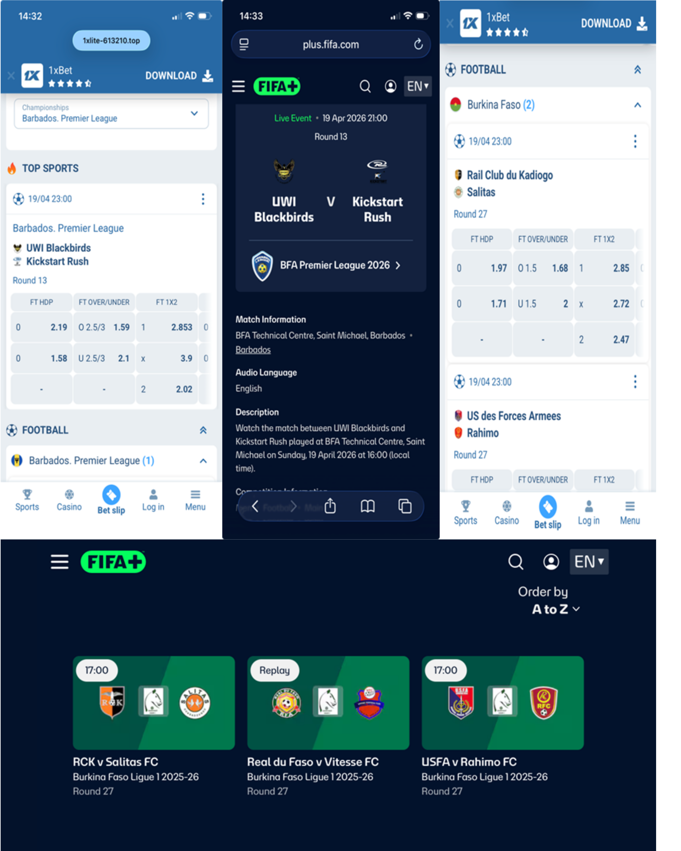
Club games in Barbados (Left and middle) and Burkina Faso (right and bottom) streamed on FIFA+ and available for live betting on 1xBet.
Like many betting operators taking bets in countries where online sports betting is banned, 1xBet, which was thrown out of the UK in 2019 for operating a Pornhub casino, has licences from jurisdictions such as Anjouan and Curaçao. These flimsy offshore licences typically have weak or non-existent controls on money laundering and do not require licence holders to report suspicious betting, which can indicate match-fixing.
Match-fixers often target games at these lower levels as there are fewer protections for players, who are easier to corrupt due to poor payment and conditions.
FIFA+ and betting markets in countries where gambling is banned
In many parts of Africa, gambling regulation is still catching up with the growth of online betting. But in Asia, FIFA’s commercialisation of FIFA+ for betting purposes directly conflicts with national legislation.
The Asian Football Confederation has 47 members, and online sports betting is prohibited in many of them, often for religious reasons. Research by Play the Game found domestic matches streamed on FIFA+ in April 2026 from eight AFC members where sports betting is banned: Bhutan, India, Indonesia, Laos, Macau, Malaysia, Oman and the United Arab Emirates.
Domestic geo-blocking is put in place to stop residents from accessing illegal betting sites, but this can be easily bypassed by anyone with a VPN [Virtual Private Network] on their phone.
As Play the Game revealed earlier, streams of club games on FIFA+ are being used on the betting websites of illegal operators and, despite the Stats Perform deal this practice continues.
Matches in the newly launched Oceania Professional League, which includes teams from Australia, New Zealand and several Pacific Island nations, are streamed on FIFA+. Those same streams have been used by 1xBet to offer bets on these matches.
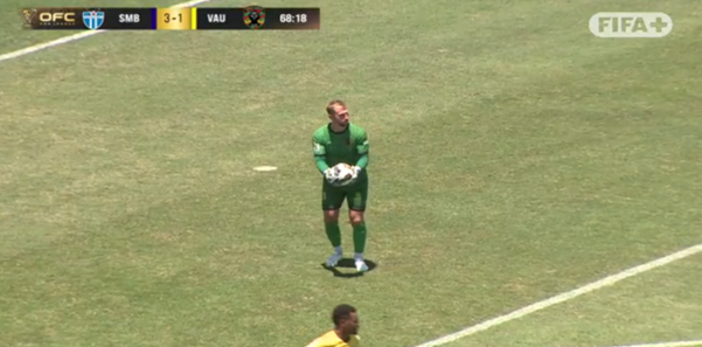

South Melbourne from Australia play Vanuatu United in the Oceania Pro League in February on FIFA+ (top). On 1xBet, the FIFA+ watermark in the top right has been replaced by ‘Live’.
When FIFA and Stats Perform signed their agreement, a promise was made to provide education to smaller federations about how their data would be used and the risks of appearing on betting markets.
Months later, the president of one federation, whose largely amateur league is on both FIFA+ and on illegal betting markets, told Play the Game: “I will not say it’s been directly offered, but we are certainly aware of it, and it will be addressed.”
The federation only became aware of the issue after being alerted by Play the Game.
Play the Game asked Stats Perform what support is being provided to FIFA’s Integrity Unit regarding FIFA+ content, and how it prevents the data it collects from being scraped and sold to illegal betting operators. No response was received.
Play the Game also put a raft of other questions to FIFA about its approach to betting for this article. FIFA did not respond.
Nick McGeehan, director of advocacy group FairSquare, which is pushing for widespread reforms to how football is governed, said FIFA’s approach reflects the direction of the organisation under Gianni Infantino.
“FIFA is now completely beholden to commercial interests, acting in a manner directly contrary to the interests of the game, and convinced both of its infallibility, and of its immunity from any sort of accountability.”
McGeehan added: “This is yet another example of why policymakers everywhere need to be looking hard at FIFA and questioning why it is that a sector that is so ingrained in our political, social and economic life is granted the ability to regulate itself despite mountains of evidence of its dysfunction.”
Additional questions to FIFA
Play the Game asked FIFA:
- What protections has FIFA put in place to protect members at associations whose club matches are on FIFA+ and are being exploited for betting purposes?
- FIFA+ is livestreaming games in countries where online sports betting is illegal, such as Bhutan and Malaysia. Will FIFA stop the collection and sale of betting data from these games?
- How is FIFA preventing the data collected by Stats Perform from being scraped and sold to illegal betting operators?


