
'Greed' and loopholes: how cricket's 55 million USD development fund gets gamed
The International Cricket Council distributes tens of millions of dollars per year in development funding through a system insiders say is loosely monitored and easily manipulated, a Play the Game investigation has found.
Cricket’s power brokers gather in Edinburgh this week for the Annual Conference of the sport’s governing body, the International Cricket Council (ICC). On the agenda: how to divvy up the game’s money. Not on the agenda: how the system that hands out the funds is being gamed, insiders say.
“After 28 years of the ICC's development programme”, one administrator told a Play the Game survey, “GREED is still the key to earning money, sacrificing national cricket development”. Speaking with Play the Game on condition of anonymity, some member-country administrators raised concerns around the potential for fraud and lack of accountability in the global development programme run by the ICC.
“There’s an enormous amount of money floating around”, said another chairperson. “The programme is designed to enhance certain countries, and make the others survive just enough that they don’t die.”

Board representatives gathered at the ICC headquarters for the visit of ICC Chair Jay Shah in December 2024, in Dubai. This week, board members reconvene in Edinburgh for the ICC's Annual Conference. Photo: Francois Nel-ICC / ICC via Getty Images
A quick guide to how the cricket money flows
The ICC has 12 Full Members and 98 Associate Members. Full Members like India, Australia, and England take 88.8% of the organisation’s budget, allocated mainly by the commercial value they bring to the ICC. India alone takes nearly 40% of the ICC’s annual earnings – largely thanks to its vast broadcast market.
The Associate Members “where cricket is firmly established and organised”, according to the ICC, operate mostly on volunteer labour, with few having more than one or two full time staff.
The ICC distributes the remaining 11.2% of its budget among the Associate Members through two funding streams: a competition grant – participation and reward money for ICC tournaments; and a ‘Scorecard’ grant – a payment meant to incentivise the growth of grassroots cricket. The latter is allocated based on a so-called Scorecard containing self-reported statistics including how many seniors and juniors play, the number of pitches available, and how much funding members raise outside the ICC.
Based on the Scorecards, members are ranked and placed into 14 funding tiers – determining how much they receive.
Team India lifts the trophy after winning the ICC Men's T20 World Cup Final 2026 against New Zealand. India is one of the ICC’s twelve Full Members, who together take 88.8% of the organisation’s budget. Photo: MB Media / Getty Images
According to documents obtained exclusively by Play the Game, the total pot for Associate Members in 2026-27 is 54.9 million U.S. dollars (USD), with the Scorecard grant making up just over half.
Global cricket development funding 2026–27
Total: 54,898,000 USD
Scorecard grant | Competition grant |
29,149,000 USD | 25,749,000 USD |
53.1% | 46.9% |
Source: ICC 2026-27 Cricket Grants (document obtained by Play the Game).
Top tier countries like the United Arab Emirates and Scotland each receive 1.02 million USD in Scorecard funding. Those at the bottom, like Iran and Saint Helena, receive 26,000 USD.
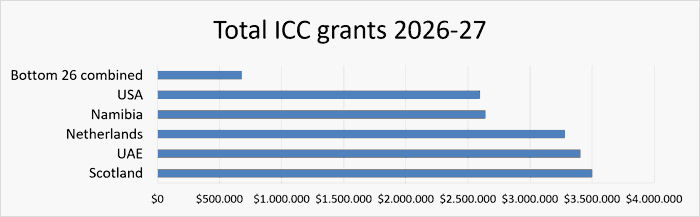
The cricket funding gap in numbers: the 26 lowest-ranked members receive 26,000 USD each – combined, less than a fifth of what the top-funded country, Scotland, receives. Source: ICC 2026-27 Cricket Grants (document obtained by Play the Game).
For lower ranked boards, a difference of one place in the rankings can mean a dramatic funding swing. The Philippines, for example, rose from 57th to 47th between 2024 and 2026, jumping three tiers and more than tripling its Scorecard funding from 65,000 to 237,000 USD.
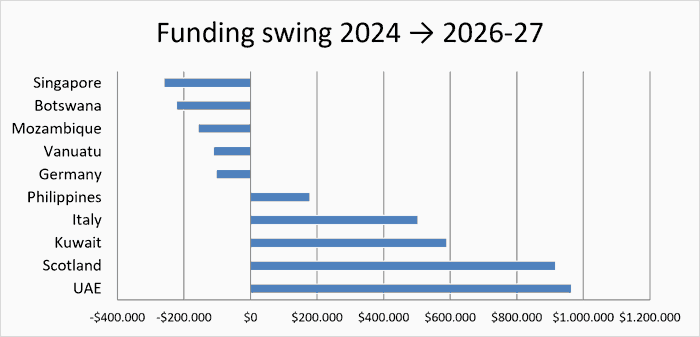
Sharp funding swings between cycles: UAE and Scotland each gained close to 1 million USD – largely through competition grants, while boards like Singapore, Botswana and Mozambique saw their funding fall by up to 260,000 USD. Sources: ICC Funding Model 2024, ICC 2026-27 Cricket Grants, ICC 2026-27 Scorecard (documents obtained by Play the Game).
This is not to suggest the Philippines’ growth is illegitimate. Rather, it illustrates the powerful incentive to keep numbers rising and avoid a drop at all costs. Combined with patchy oversight, insiders say this creates fertile ground for dishonesty.
Journalist Bertus de Jong, who has covered Associate cricket for more than a decade, put it bluntly: “Scorecard fiddling is utterly endemic”.
Cricket's disappearing numbers
One key source of transparency has quietly disappeared.
Around six years ago, the ICC stopped publishing its Census, which detailed participation and infrastructure across all Associate Members. The last time the Census appeared in official communication seems to have been a 2020 blog post, with a summary of key figures rather than granular data.
With public data scarce, Play the Game commissioned a survey to all 98 Associate Members, requesting their most recent Scorecard submissions and their views on the system.
Of the 96 reachable boards, 80 did not respond, 10 declined, and just six offered comment. Only Norway shared its data.
Greig White, the Isle of Man’s development officer, said, “all good thank you from our perspective”, adding that any concerns would be raised “through the committees rather than the press”.
“You can manipulate the data”
Given the amateur nature of many boards, a 6% participation rate is unsurprising. More revealing were the comments from those who did speak.
“You can manipulate the data”, said Yousuf Gilani, chairman of Norway’s cricket federation. “How does the ICC quality-check what countries have done, what they have been writing in the Scorecard?”
Gilani said Norwegian cricket does not rely heavily on ICC funding thanks to government support, but argued the Scorecard is still “a good thing to have” for global development.
He disputes how the ICC counted Norway’s data – for instance, claiming the board reported 80 junior women players, not the zero recorded by the ICC. Junior participation is the most heavily weighted category in the Scorecard and therefore the most valuable. As a result, he said, Norway sits one tier lower than it should – costing 70,000 USD in funding – and at rank 44, misses out on ICC voting rights typically granted to the top 40.
He and other sources also criticised the lack of adjustment for geography and demographics.
“Norway has only a three-month season”, Gilani said. “Spain has a nine-month season, and still we’re compared on the same Scorecard. That does not make sense.”
“80% of the countries don’t understand how to report [the Scorecard]”, he added. “It’s only the ICC administration that understands.”
ICC Europe Development Officer Esther de Lange, speaking on the BBC Stumped podcast in April, acknowledged that European cricket boards face significant capacity constraints: “There's always limited amounts of money available, limited amounts of time for people to do things that need to be done”.
ICC Full Members India and England during a T20 international in 2026. Unlike Associate Members, they aren't assessed through the 'Scorecard' system to determine their funding. Photo: Dan Istitene / Getty Images
The loopholes no one closes
For the chair of another board, speaking anonymously due to ongoing discussions with the ICC, the Scorecard is not just misunderstood. It’s misleading.
“I’m told that if I have a team in a competition that has 11 players on it, they count as 15 for the Scorecard. That’s already four ghosts.”
Guidelines obtained by Play the Game state that “Teams consisting of the same players, playing across multiple competitions, should only be counted once”. The source said that wording allows for interpretations that inflate numbers.
“There is no hard and fast understanding on how the counting is being done”, they said. “Most of this fraud is in the loose interpretation. It’s in the loopholes of the system that’s being exploited.”
“There are people out here committing fraud, and it’s financial fraud, because they are taking money based on false information.”
“I’m told that if I have a team with 11 players on it, they count as 15 for the Scorecard”
Associate cricket chairperson, on condition of anonymity
Play the Game did not independently verify specific instances of fraud.
So how much auditing is actually done?
Guidelines say regional officials will request evidence for “at a minimum, 30% of the data submitted”.
But de Jong said the Census is “more or less entirely self-reported”, and regional bodies “don’t have the resources to actually check”.
He cited long standing implausible data: “Suriname claims they have 10 turf wicket facilities. I know for a fact they have none”.
Suriname’s cricket board did not respond to a request for comment.
The anonymous chair said auditors tend to focus on big variations: “If you’ve been cheating and you’ve always been cheating, then it looks like you’re not cheating because the numbers are the same”.
Two anonymous survey respondents said they had been audited, one as recently as 2024. One described the Scorecard as “modelled on the big cricketing nations”, arguing it shows “little understanding” of how sport develops in their region.
Gilani suggested more transparency could help: “They should publicly announce all the Scorecards for the European side, for the African and the Asian side… on a webpage where everyone can follow”.
‘Mercenary’ cricket
The ICC’s funding model increasingly rewards tournament performance over grassroots development. Some of the sources Play the Game interviewed argue this encourages countries to recruit foreign-born players rather than develop local talent.
Children play cricket during National Cricket Week in Edinburgh, an event showcasing the importance of grassroots cricket and its power to inspire the next generation. Since 2024, the share of reported junior players across the ICC's Associate Members has declined by over 5%. Photo: Ian MacNicol / Getty Images for Yorkshire Tea
Competition grants now represent almost half of Associate funding, up from just over a third in 2022, according to the data we obtained. For instance, each country playing at the Cricket World Cup League 2 – the main route through which Associate nations can qualify for the One Day International (ODI) World Cup – receives 1.16 million USD, more than the highest development grant.
Under ICC eligibility rules introduced in 2018, players need only prove their “primary and permanent home” has been in a country for three consecutive years to represent its national team; no citizenship required.
Our data also shows that the UAE, home to the ICC’s headquarters, appears to be reaping the rewards. Ranked top of the Scorecard, its funding has increased from 2.44 to 3.40 million USD this period, driven almost entirely by competition grants. Only 11.4% of its 102,705 registered players are juniors, compared to 37% for fourth-ranked Scotland.
“The top eight countries are getting 20 million out of [more than] 50 million dollars”, said one former regional administrator, also granted anonymity. “Four of those countries don’t have [homegrown] players. They play mercenaries.”
Scorecard data shows stark disparities in youth pipelines: two of the eight countries receiving the highest competition grants report junior participation below 15%, while one reports over 75%.
Mown grassroots
From 2024–2026 among all Associate nations, the share of reported juniors playing cricket declined by 5.4%
Source: ICC data (document obtained by Play the Game), excluding the “modified playing” category, which includes non-traditional or educational forms of cricket.
Beyond the boundary: the Iceland case
The system frustrates even those outside it.
Iceland Cricket, with a national team, five clubs and three domestic competitions (plus a cult following on the internet), is not an ICC Member.
Chairman Bala Kamallakharan said requirements for new ICC membership, particularly around women’s activity, are difficult to meet, while existing members face little scrutiny.
“There is a lot of smoke and mirrors surrounding cricket activity”, he said. “Associate Members wouldn’t put their funding at risk by saying they no longer meet membership requirements.”
“We are following strict rules [to try and join the ICC]; those already in the system are not.”
The Australia team celebrates victory after the ICC Women's T20 World Cup England & Wales 2026 Final. ICC membership requirements are difficult to meet, especially those around women's activity, says Iceland's board chairman, Bala Kamallakharan. Photo: Alex Davidson-ICC / ICC via Getty Images
No change of ends: privileging the privileged
Reform looks unlikely.
Voting rights determine who can influence funding rules, eligibility criteria, and audit frameworks. While commonly believed that the top 40 Associates hold voting rights, an ICC document obtained by Play the Game shows that in 2024, 39 of the top 47 did, with exceptions including boards in administrative turmoil like Sweden and the USA. Those rights will be exercised this week at the ICC meeting in Edinburgh.
This concentration of power makes reform difficult, sources said, as those benefiting control the votes needed for change.
The ICC did not respond to multiple requests for comment within seven months, including questions about verification procedures and whether inaccurate data had affected funding decisions.
Cricket’s inclusion in the 2028 Olympic Games will essentially exclude Associate nations, with only six men’s and six women’s teams competing. But Associates hope it will still bring more eyeballs and once-in-a-lifetime funding opportunities. All the more reason for accurate reporting and transparent governance.
For now, in a system that mostly benefits those with the money and the power, tens of millions of dollars are doled out per year based on largely self-reported statistics and scarce independent oversight.
Those calling for reform remain in a lonely place, believing the system fails the very grassroots it claims to serve.
Nothing decided in Edinburgh is likely to change that.


