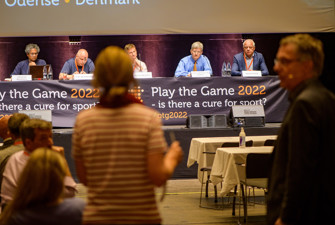
Good governance – the new sport mantra
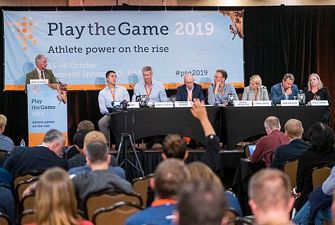
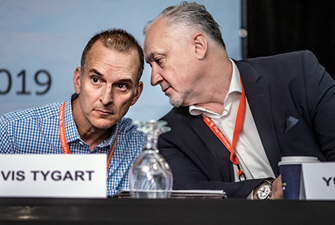
"The history of sport organizations has demonstrated an ingrained reluctance to ask obvious questions or to challenge officials whose conduct has been inadequate or improper," said Richard W. Pound in his presentation at Play the Game 2019.
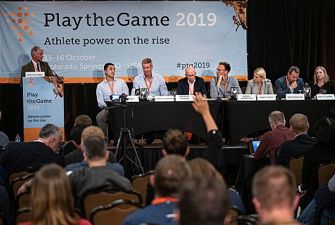
Presentation by Richard W. Pound, member of the International Olympic Committee, at Play the Game 2019, Monday 14 October 2019
Good governance is the new sport mantra, the current Flavour of the Month for sport organizations. It now ranks up there with “transparency,” “inclusiveness,” “diversity,” “accountability,” and “athlete-centered.” No self-respecting sports administrator would venture out in public without a quiver full of these comforting and suitably vague terms, to be sprinkled liberally throughout any discussion or debate on principles that should apply to a particular organization, indeed, to all organizations. In an academic context, it would be as unthinkable as failing to over-use expressions such as “paradigm shift” and “student-centered."
The advantage (for any speaker) of using mantra is that it merely requires sufficient memory to use the word, without the necessity of explaining what it means. It is reminiscent of Lewis Carroll’s Through the Looking Glass, “When I use a word,” Humpty Dumpty said, in rather a scornful tone, “it means just what I choose it to mean – neither more nor less.” “The question is,” said Alice, “whether you can make words mean so many different things.” “The question is,” said Humpty Dumpty, “which is to be master – that’s all.”
There are actually two questions: first, what does the expression “good governance” mean and second, does the user really mean (or perhaps even understand) what she or he has said? Deconstructed, does the listener understand the meaning of the word as used by the speaker? Is there, as is asked in contract law, a meeting of the minds, or have two ships merely passed each other in the night?
So, then, what is good governance? Of what does it consist and how is it exercised?
In a perfect world, it would mean a set of rules (or, at the very least, guiding principles), adopted by the decision-making apparatus of the organization, that reflects the values and objectives of the organization and which apply to the conduct of members and adherents in the context of the organization’s activities. The rules will apply to the conduct of all activities of the organization, including how decisions are reached, how decisions are communicated to those affected by them, how and by whom the rules will be interpreted, what are the consequences of non-compliance with the rules, what appeal process will apply, how will impartiality be assured and, what are appropriate and proportionate sanctions in the circumstances.
As all of us know, sport is an activity governed by rules that have been accepted by the participants in the particular activity, as an essential condition of their participation, and applied by impartial officials familiar with those rules. These principles do not reflect a complicated calculus, even if the underlying activity and its organisation may be complex. In fact, the calculus itself is quite simple.
Governance begins with a shared commitment to design, draft and implement the applicable rules in a coherent and equitable manner, so that participants, officials and spectators alike will be able to understand them and respond accordingly.
Simply having such rules in place, however, is not sufficient to produce good governance. An example of this can be seen from the early days of WADA, when, to demonstrate purported compliance with the World Anti-Doping Code, such compliance was self-assessed by Code signatories: did the signatory have anti-doping rules in place and were anti-doping tests conducted? An overwhelming number of signatories were able to respond positively. The difficulty, from the perspective of good governance, was that having rules and conducting tests established absolutely nothing, because the questions did not address the crucial matters of how the rules in place were to be administered and what tests were to be performed, on how many athletes, under what circumstances and for what substances or methods.
Good governance requires rigorous due diligence, not a check-the-box approach. Further factual inquiry and purposive analysis of organizational conduct are required. This is particularly important because the difference between good governance and poor governance almost always results from inadequate application of the rules that have been adopted or from deliberate mis-application of them. Such conduct failure emanates from persons within the organization, sometimes encouraged or aided and abetted by third parties.
The history of sport organizations has demonstrated an ingrained reluctance to ask obvious questions or to challenge officials whose conduct has been inadequate or improper. This has not been limited to doping in sport (although doping is an aspect replete with examples of such conduct), but extends to conduct of athletes and officials on and off the field of play, discrimination, sexual abuse and harassment, falsification of data and identities, match fixing, financial misconduct, selection of hosts for sporting events and much more.
The same history shows that has been easier for sport organizations to ignore inadequate or improper conduct than to confront it or to stop it. Decisive action, absent some form of scandal or public disclosure of the existence of the conduct, has been limited and sporadic at best. That FIFA was unaware of the existence and extent of the endemic financial misconduct within the organization beggars belief. That the ISU was unwilling to confront the obvious corruption of judging in figure skating is undeniable. Disclosure of the IAAF doping and extortion scandal was made more difficult because it was the IAAF leadership that directed it. Cycling resolutely denied the existence of its doping problem; faced with incontrovertible evidence of doping, time after time, the ICU dismissed the conduct as that of outliers, announcing firmly, after each revelation, that the peloton was now “clean.” There are far too many other examples for the scope of a paper at this conference.
Sport officials have clearly been conflicted. They wrestle with personal ambitions for advancement within the organizational hierarchy and the seemingly irreconcilable duty to exercise sound and dispassionate judgment regarding the conduct of colleagues - and even friends - in the best interests of the applicable rules, those affected by them and the organization. Too often, the U.S. congressional adage of “if you want to get along, go along” has summed up the prevailing attitude. Independent and principled conduct has been rare.
Criticism of organizational conduct is not welcome, especially amongst the leadership, and often results in marginalization, loss of positions and isolation of those daring to be critical. Whistleblowers are severely treated and, more often than not, tend to receive harsher treatment than the perpetrators. Athletes have been actively discouraged from making complaints about harassment and sexual abuse. Those who come forward despite such discouragement are often given hostile or dismissive treatment.
It has now become clear, especially in recent years, that sexual abuse, in particular, of both female and male athletes has been far more extensive than was generally suspected. On the other hand, such abuse was often widely known within organizations, yet nothing was done to address the issue, nor to confront the abusers. It is distressing to think how much abuse was allowed to continue because, “if you discipline or accuse coach x, there go five Olympic medals.”
The outcome has been that good governance has been sacrificed on the altar of a grace and favour culture that has allowed incompetence, corruption and negligence to flourish, at the expense of the integrity of competitions, the legitimate aspirations of athletes, the expectations of spectators and respect for the organizations that purport to deliver ethical sport.
From Mantra to Movement
There is little new in what has already been said.
The governance challenge for the future is to convert analysis into action, in a manner that recognizes the weaknesses of human nature.
The classic doctrine of separation of powers can provide some guidance. International sport organizations are at particular risk because power is centralized and the membership is thinly spread throughout the world. In microcosm, the same is true within national organizations as well. Information, the real “currency” in governance, is tightly controlled in the planet-moon structure of the president and general secretary relationship and shared sparingly for purposes of organizational control.
Few meaningful policy decisions are taken by the membership, which is given insufficient information and almost no opportunity for rigorous discussion of policy alternatives. Challenges to “recommendations” from the executive structure are not welcome, indeed, are regarded as attacks on the leadership.
While few would dispute the thought that (say) an international federation should have a solid base of directors that are thoroughly familiar with the sport and its requirements, there is nevertheless a need to ensure that there is a meaningful presence of persons from outside the sport “bubble.” They bring broader experience, independence of judgment and a different perspective on organizational governance, all of which are highly beneficial. Such positions also provide access to board positions for women who might not be able to break through the “blazer” barrier within the sport. Independent directors can ensure that real, rather than announced, transparency exists with respect to decisions.
The ethical component of governance also requires both a willingness to recognize the need for, as well as an independent mechanism to make, any necessary determinations. This, too, calls for some independent outsiders to be part of the process and should extend to a significant percentage of the Ethics committee. From an operational perspective, it may well be necessary to have the Ethics committee report to the president of the organization with its recommendations or findings, but there must be an understanding that failure to accept its recommendations will lead to the principled resignation of (at least) all the independent members. The members of the organization should elect the Ethics committee.
Term limits are particularly necessary to avoid the excesses that have plagued an embarrassingly large proportion of sport organizations, especially in the executive ranks. A figure of 10 years may well be appropriate, given the tempo of international activities in the modern era. If you have not accomplished what you want to do in 10 years (or at least set in motion the process to achieve such goals), it is unlikely that you will do so in the course of an extended term, leading to “tourist” or non-productive leadership.
Disputes are inevitable and should be resolved as expeditiously as possible. Although most litigation is the result of a failure of reasonable people to agree, an organization must provide for the resolution of disputes. In the interests of the collegiality that should exist within an organization, an internal appeal process should be established as a first level, with access to some form of external arbitration (such as CAS or a domestic arbitral tribunal) should the internal process not produce an acceptable outcome.
Athletes must be protected from abuse and harassment. Responsibility for the duty to monitor and report on any such activities must be “owned” by someone in the organization who must report regularly to the board or at least to the Ethics committee.
The same is true regarding protection of clean athletes from doped athletes. Because of the specifics of doping, the technical execution of certain matters, such as testing, can be delegated, but the duty of protection remains an organizational responsibility, which must insist on regular consultation, agreed programs and reporting to the board.
Finally, a voice must exist for the athletes. It will generally be true that current athletes have little exposure to (nor interest in) corporate governance and organizational issues, but they must at least see those processes in action and be given an enlightened platform from which they can raise issues particularly relevant to athletes and competitions.
These elements require constant surveillance, which can be provided by a board committee on governance charged with reporting regularly to the board and liaison with the other aspects already identified. The positive duties to act and to report will significantly reduce the opportunities for inadequate or unacceptable organizational conduct.
Good governance will require leadership and commitment to the underlying principles. Based on the experience to date in sport organizations, it is naïve to think this will happen on its own or without a series of potentially crippling crises. Nor is it likely to come without the application of the “carrot and stick” context.
Both leadership and incentive could be provided by the IOC. The IOC went through its own crisis and emerged from it with greatly enhanced governance and financial transparency, providing it with useful and shareable experience. It also provides Olympic sports federations with significant funding. It would not be difficult to develop a set of governance guidelines for those federations and to link receipt of funds to compliance with such guidelines. It has already done so with AIBA, on an ad hoc basis and a principled linkage of good governance to the receipt of Olympic revenues would not be a huge ethical leap.
Any such change will, without doubt, generate screams of outrage and frenzied invocation of the well-known mantra (to add to the many others that exist) of “autonomy.” As a mantra, however, it is outdated. Autonomy in the 21st Century is not an entitlement. It must be earned and deserved. An Olympic federation unwilling to demonstrate good governance has not earned and does not deserve to share in Olympic revenues. Olympic federations that practice good governance can then insist that their national federations do the same.
To paraphrase the Chinese proverb, a journey of a thousand miles begins with a single step.
In a somewhat similar vein, let me close with some lines from Shakespeare’s Julius Caesar:
There is a tide in the affairs of men,Which, taken at the flood, leads on to fortune.…On such a full sea are we now afloat.And we must take the current when it serves, or lose our ventures.