
Qatar 2022 documentary fails its own test
The documentary A Game of Double Standards puts Qatar’s critics in the dock. But its own case rests too often on anecdotes, omissions and convenient comparisons.
Near the end of the new documentary A Game of Double Standards, Hassan Al-Thawadi, who oversaw Qatar’s 2022 World Cup preparations, recalls something he believes an editor at The Times wrote. Or perhaps The Sunday Times – he cannot quite remember.
Al-Thawadi says this editor was talking to another editor, from an unnamed news platform, who had been told to cover only the matches if there was nothing negative to report on Qatar 2022 – “but don’t cover the positive sides”.
The documentary revisits some of the controversies surrounding the 2022 World Cup: corruption allegations, the bidding process, migrant workers’ treatment, LGBT+ rights, and how the media covered the first FIFA World Cup held in an Arab country. Its underlying argument is that Qatar faced criticism other hosts escaped.
As Al-Thawadi tells the story, the film cuts between him and jubilant supporters. The anecdote serves the film’s argument that Qatar faced media bias and double standards. Viewers are shown neither the article nor its author.
So I went looking. Al-Thawadi may be recalling a piece by David Walsh, the chief sportswriter at The Sunday Times. Shortly after the tournament, Walsh wrote that a fellow journalist from another newspaper had told him his London desk did not want good stories about the World Cup.
If accurate, that newsroom instruction deserves scrutiny. But Walsh was describing one unnamed journalist at one unnamed newspaper. It tells us nothing on its own about how the wider press covered Qatar. The documentary leaves that question hanging.
It also leaves out Abdullah Ibhais, a former media manager at Qatar’s Supreme Committee for Delivery and Legacy, where Al-Thawadi was secretary general. In that role, Ibhais helped craft Qatar’s public narrative about the tournament. He later blew the whistle on how Qatar profiled journalists and managed their access. For a film concerned with media bias and who shaped the story of Qatar 2022, his account should be difficult to ignore.
This article is based on the 47-minute version embedded above, which is publicly available to viewers in Europe on YouTube and Al Jazeera’s website. Play the Game is aware of a longer, 87-minute version but has been unable to access it.
When comparison becomes deflection
The film does give some of Qatar’s critics a hearing. For example, a representative from Amnesty International is featured describing labour exploitation. Al-Thawadi himself acknowledges “horrible” living conditions “at a certain point in time” for migrant workers.
Some of the film’s complaints about the coverage deserve examination, too. A Kenyan security guard who worked in Qatar for two years recalls getting to know journalists from Switzerland’s RTS and France 24, as well as reporters from Denmark and the Netherlands. He accuses some of them of producing biased stories because they just wanted to criticise Qatar and the World Cup. The film does not identify the particular reports behind that broad accusation.
Asked whether journalists changed his words, he says they did, both in articles and on video. He then describes a specific complaint about how his accommodation was portrayed: footage of a worse neighbouring building, he says, was used to illustrate where he lived.
The film shows footage from RTS and includes the broadcaster’s rejection of claims that it influenced interviewees or altered their responses. The sequence leaves viewers with allegations of altered words and misleading footage, but too little evidence to determine what happened.
The trouble deepens when the film turns individual grievances into a verdict on “the media”. Establishing double standards requires comparing how particular outlets covered similar events, how prominently, and what evidence was available at the time. A parade of hostile headlines does not do that work.
Guido Tognoni, FIFA’s former communications chief, offers a clear example of the film's unexamined comparisons. He says that few complain when sport goes to China or Russia, whereas they “like to beat Qatar”. Later, Amnesty International’s Steve Cockburn recalls the considerable scrutiny Russia received and suggests that the sheer scale of Qatar’s project may help explain the greater attention. Cockburn offers an important counterpoint, but the film does not test these competing accounts against the coverage.
A sequence about the Paris Olympics presents another example. Ambet Yuson, general secretary of the Building and Wood Workers’ International, says labour inspectors had poorer access to sites in Paris than in Qatar, and that conditions at some workplaces were worse. The film also draws on journalist Rosa Moussaoui and an undocumented worker as evidence of exploitation in France.
Yuson goes further, arguing that abuses in France and Tokyo received too little coverage while Qatar became the focus. His experience gives weight to the comparison of working conditions. But these testimonies alone cannot establish the documentary’s claim that news organisations applied different standards.
FIFA president Gianni Infantino offers the film’s most theatrical version of deflection, with his demand that Europeans spend 3,000 years apologising before giving moral lessons to others.
Europe’s historic crimes are real. But if atoning for the past becomes a condition for criticism, many of those in power will never run short of excuses for avoiding it.

FIFA president Gianni Infantino addresses journalists in Doha on 19 November 2022. At the press conference, he argued that Europeans should spend 3,000 years apologising before giving moral lessons to others. Photo: Christopher Lee / Stringer / Getty Images
What the 6,500-death toll does – and does not – show
The film’s treatment of the worker death toll also deserves a closer look. It dwells on a Guardian investigation published on 23 February 2021 under the headline “Revealed: 6,500 migrant workers have died in Qatar as it gears up for World Cup”.
The film shows the amended headline from 2 March 2021: “Revealed: 6,500 migrant workers have died in Qatar since World Cup awarded”. The original wording could suggest a closer connection between the deaths and tournament preparations; the amendment clarified the time period covered.
Nicholas McGeehan from the advocacy group FairSquare told Deutsche Welle that the reporting was important but questioned whether the newspaper should have anticipated how the figure in its headline would be misinterpreted. The documentary itself includes an example of that confusion: a clip claiming that 6,500 workers died building World Cup stadiums.
But it is also not what the Guardian’s investigation established. Its published figures totalled 6,751 deaths among migrants in Qatar. The data covered 2011 to late 2020 for nationals of India, Nepal, Bangladesh and Sri Lanka, and 2010 to 2020 for Pakistani nationals. The Guardian’s opening paragraph described this as “more than 6,500”. It did not establish where each person worked.
The Guardian’s original headline (top) and its amended version (bottom). The article was published on 23 February 2021; its correction note dates the headline change to 2 March 2021. The wording changed from “as it gears up for World Cup” to “since World Cup awarded”. Screenshots retrieved through the Internet Archive’s Wayback Machine.
The voices the film chooses
The treatment of whistleblowers raises a different question: how much of a witness’ account does the viewer get to hear?
The film revisits allegations made in 2011 by Phaedra Almajid, a former Qatar bid media officer. She claimed that three members of FIFA’s executive committee had each been offered 1.5 million US dollars in exchange for voting for Qatar. Her allegations attracted widespread media attention, but she retracted them shortly afterwards.
The next sequence shows headlines about her retraction, followed by a BBC clip in which she says she “fabricated the whole story.” A caption acknowledges that she later claimed to have retracted under duress, but the film offers little explanation of what she meant.
In a 2014 interview published by Play the Game, Almajid said she had signed the retraction after threats of legal action, without a lawyer, and in fear for her family.
Beyond her statements to the media, Almajid gave testimony to a wider investigation into the bidding for the 2018 and 2022 World Cups, led by American lawyer Michael Garcia. In November 2014, FIFA ethics judge Hans-Joachim Eckert published a summary of Garcia’s findings.
As the Associated Press reported, Almajid complained that the summary discredited her and breached the confidentiality she had been promised. Although it did not name her, its account made her readily identifiable.
Garcia’s full report, which refers to her as the “Qatar Whistleblower”, was sharply critical of her credibility. The investigators said they had not based their conclusions on the information she provided.
The report also quotes an October 2011 letter from a lawyer representing Qatar’s bid committee, sent after Almajid had withdrawn her claims. It warned that legal action would be “very likely” if she made further allegations about the committee. Almajid regarded the letter as another threat.
Garcia's investigators, however, found no evidence beyond her own testimony to support her claim that intimidation by the bid team had caused her to retract.
In the documentary, Al-Thawadi presents Garcia’s investigation as vindication. He says “we had done nothing wrong”, and later argues that nothing conclusive had been established against Qatar.
The film also includes a news clip reporting that Garcia considered FIFA’s summary of his investigation “flat out wrong.” Garcia later resigned from FIFA’s Ethics Committee in protest. In his resignation statement, he accused Eckert of omitting material and misrepresenting the report’s facts and conclusions.
The film leaves out a finding that complicates Al-Thawadi’s account. It concerns Aspire Academy, a sports training centre established by the Qatari government. The report states that the academy’s resources were used to win favour with FIFA’s executive committee members, creating at least an “appearance of impropriety” and serving “to undermine the integrity of the bidding process”.
Al-Thawadi also attributes to Garcia a conclusion that “every bid” breached the bidding rules. The report’s conclusion refers to rule violations by individual members of various bidding teams. The film does not explain the basis for Al-Thawadi’s broader claim.
Invoking breaches by other bidders does not answer the findings about Qatar. Failures across the bidding process are a reason to examine each bid, not a defence of any one of them.
Selectivity extends to the documentary’s own interviewees. Former Australian World Cup bid official turned whistleblower Bonita Mersiades offers valuable insight into FIFA’s bidding culture. But the film leaves out an allegation from her 2018 book Whatever It Takes that bears directly on Qatar: she describes negotiations over a 100 million USD bonus from Al Jazeera to FIFA, payable if Qatar won. The Sunday Times later reported that the conditional payment appeared in a 400 million USD broadcasting agreement signed 21 days before the vote.
beIN Sports, formerly Al Jazeera Sport, characterised the bonus as “production contributions” that were “standard market practice and are often imposed upon broadcasters by sports federations and sports rights holders … and [in] no way intended to influence the outcome of the vote.”
The clause does not prove that votes were bought. But a payment conditional on Qatar winning is directly relevant to the bidding process.
For a film that chooses Mersiades as a guide to the murky world of World Cup bidding, leaving this part out is hard to understand.
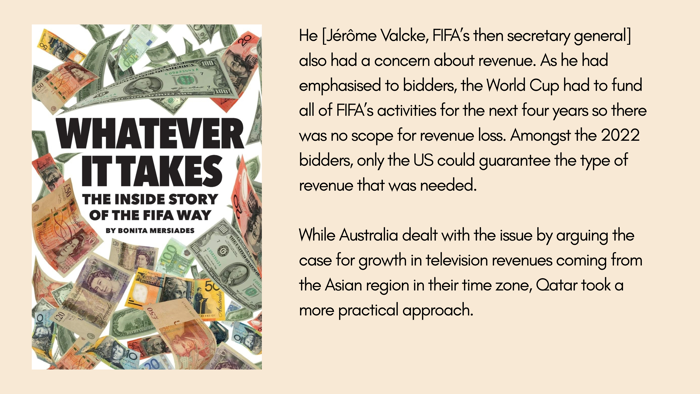
An excerpt from Bonita Mersiades’ book Whatever It Takes: The Inside Story of the FIFA Way (2018), describing negotiations for a US$100 million bonus payment from Al Jazeera to FIFA if Qatar won the right to host the 2022 World Cup.
How the film frames the debate
At several points, the film’s editing seems to supply a conclusion that its evidence cannot carry. Simon Chadwick, one of the film’s academic voices, describes Qatar as almost an “innocent victim”. He also says that people, groups, and organisations orchestrated “anti-Qatari, anti-Arab and anti-Muslim sentiment.” A rapid montage follows, with broadcasters invoking corruption and human rights. It creates a chorus of condemnation without showing evidence that any of them were part of the campaign Chadwick describes.
That narrative is set from the start. Near the opening, fellow academic Danyel Reiche calls Qatar 2022 “a good case of double standards”. Seconds later, the title appears over a World Cup trophy topped with scales of justice, amid smoke and powerful floodlights.
Viewers are given incomplete information about the contributors’ own connections to Qatar. Chadwick served as consultant research director at the Josoor Institute in 2015, an organisation established by Al-Thawadi’s Supreme Committee, while Danyel Reiche led a World Cup research initiative at Georgetown University in Qatar.
Chadwick and Reiche’s on-screen introductions identify academic posts elsewhere without mentioning those roles. Such connections do not invalidate their views, but they are relevant information for viewers being asked to weigh their assessments of Qatar and its critics.
Who actually shaped the coverage?
The missing context extends beyond individual contributors. The film devotes far more attention to critical headlines than to Qatar’s efforts to generate favourable stories.
In Qatar Tourism’s 2022 stopover campaign, David Beckham visits markets, museums and the desert on a carefully packaged 48-hour trip. “I cannot wait to bring my children back,” he says. The Supreme Committee separately enlisted Xavi, Cafu and Samuel Eto’o among others as its ambassadors to promote the tournament and its legacy programmes.
Tourism advertising is meant to flatter its subject. There is nothing unusual about that. But a documentary about how Qatar’s image was shaped should make room for this organised promotion alongside the criticism it examines.
Abdullah Ibhais could have offered an account from inside the Supreme Committee, but he is not part of the film. What happened to him offers a very different perspective on the film’s central question of who tried to influence the coverage.
When migrant workers protested over unpaid wages in August 2019, Ibhais urged his colleagues to acknowledge the problem and resolve it. Internal messages published by Josimar show him arguing against a misleading denial that World Cup workers were involved. In the same exchanges, Al-Thawadi urged colleagues to come up with a narrative and “put a spin on it”.
Ibhais was first arrested in November 2019 and convicted in 2021 on corruption charges, which he denies. The Supreme Committee denied retaliation and said the case arose from a corruption complaint.
In 2024, the UN Working Group on Arbitrary Detention reached a damning conclusion. It found that his detention resulted from exercising his rights to freedom of expression and conscience, specifically his refusal to deny the workers’ wage and living-condition problems and their connection to World Cup projects. It also found serious violations of his right to a fair trial. Qatar’s government had not responded to the Working Group’s request for an explanation.
The World Cup came and went while Ibhais remained behind bars. He spent more than three years in prison before his release in March 2025.
At our 2025 conference, where he received the Play the Game Award for speaking out at great personal cost, Ibhais described an organised system for managing journalists. He said the committee profiled journalists by their attitude towards Qatar, cultivated favourable coverage through invitations and exclusives, and restricted access for those deemed “problematic”. His account complicates the film’s portrayal of Qatar as the target of media bias by describing the organising committee’s own efforts to influence reporting.
The film makes room for Al-Thawadi’s recollection of an unnamed editor. It does not include the account of the former member of his own media team who says the Supreme Committee systematically sought to influence journalists.
There is relevant context behind the camera, too. Noon Films and RCD Media Group have both announced the documentary as “our film” with identical wording on LinkedIn. Media City Qatar, an institution established by the Qatari state, says RCD joined its ecosystem at the start of 2025 and describes support for its Doha expansion and other projects.
Al-Thawadi chairs Media City Qatar’s Film Committee and is now vice-chairman of its board. One of the film’s central interviewees therefore currently holds a senior position in the state-established institution that describes supporting RCD’s wider business.
Those connections do not establish who financed the documentary or who had editorial control. They are nevertheless relevant context for a film concerned with influence over coverage.
The documentary raises legitimate grievances and includes evidence worth taking seriously. The problem is the leap from those individual cases to its much larger conclusion. Again and again, the evidence is stretched: a newsroom complaint becomes an indictment of the press; other hosts’ failures become a defence of Qatar; separate critical reports become evidence of an orchestrated campaign.
That is precisely where a documentary about double standards should be most careful. Scrutiny cannot be a spotlight you swing towards your opponents and switch off above your friends.
In the end, A Game of Double Standards has chosen its title more aptly than it intended.