

From the gin craze to the gambling craze: lessons from the past for today’s fight against illegal betting
COMMENT: In 1751, the Gin Act stopped targeting street corners and small illicit shops. It went straight for the big distilleries – and it worked! This lesson could inspire us to target the betting data providers to choke off the supply that fuels the flourishing illegal market, argues Corentin Segalen.
In the first half of the 18th century, London was in crisis – not from war or plague, but from gin. London was literally drowning in gin. The drink, once a Dutch import, became the cheapest escape for London’s urban poor. A pint cost less than a loaf of bread. Street posters promised: “Drunk for a penny, dead drunk for two.”
The historian Patrick Dillon estimates that by 1743, “production of British spirits hit more than eight million gallons a year - 36 million litres. Gin was supposed to have been outlawed, but every man, woman and child in London was drinking two pints of the stuff every week.”
The consequences were devastating.
According to Jessica Warner’s research, “in some neighbourhoods in the capital, such as Holborn, the ratio of gin shops to houses was as low as one to five”.
The city recorded up to 7,000 gin-related deaths per year. In some areas, the mortality rate was higher than during the Great Plague of 1665. Infant mortality reached record levels. In parishes such as St Giles, three out of four children died before the age of five, often because they were fed gin to keep them quiet.
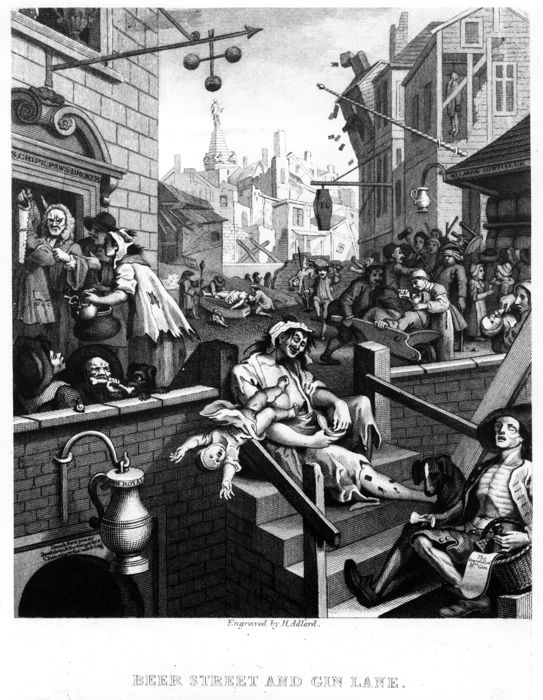
Scenes of debauchery and drunkenness in 'Gin Lane' in an engraving by William Hogarth, London, 1751. Photo Three Lions / Getty Images
The satirical engravings of William Hogarth – Gin Lane and Beer Street (1751) – captured the catastrophe: chaos, neglect, and despair. London’s working class was disintegrating under the weight of an unregulated, addictive product.
Three centuries later: the new epidemic
Fast-forward to the 21st century, and the parallels are striking.
Once again, an addictive, globalised product – online betting – has outpaced the ability of states to regulate it.
Today, illegal gambling sites operate beyond jurisdiction, often registered in offshore territories or behind layers of corporate opacity. They advertise through social media, influencer marketing, and cryptocurrency payments. They use legitimate-looking data feeds to offer real-time odds on thousands of events worldwide.
Illegal betting fuels match-fixing networks, money laundering, and consumer exploitation, much like gin once fueled crime and social decay in 18th-century London.
Operators without a licence, but with a supply chain
Illegal betting websites do not operate in a vacuum. They depend on the same global infrastructure that powers the regulated market – data, payment systems, and digital platforms.
The crucial point is this: without live data, there are no bets. Yet, many illegal sites obtain real-time sports data from the same betting data providers who serve licensed operators.
These providers collect and distribute live statistics and odds to hundreds of clients, sometimes without verifying whether the end user holds a valid national license.
This structural dependency on legitimate data flows is the Achilles’ heel of the illegal market. Just as London’s unlicensed gin sellers once bought from legitimate distillers, today’s illegal operators buy from legitimate data intermediaries.
If regulators want to make progress, they must target the upstream flow, not the downstream symptom.
In modern terms, that means:
- Holding data providers accountable for verifying their clients’ licenses
- Requiring payment processors and advertising platforms to refuse unlicensed operators
- Ensuring international cooperation so that sanctions are meaningful.
This approach mirrors the 1751 reform on gin: not punishing consumers but cutting the oxygen supply to illegal traders. When the British government tried to outlaw gin in 1736, the result was open revolt: illicit distilleries multiplied, corruption spread, and enforcement collapsed.
The same pattern repeats today. Blocking a website is easy; keeping it blocked is not. Operators change domains overnight, mirror sites proliferate, and virtual private networks make access almost impossible to control. This endless chase is the modern equivalent of the 18th-century law and order: symbolic victories that solve nothing.
What the gin epidemic still teaches us
The 1751 Gin Act did not end drinking. It ended anarchy by recognising that unregulated markets are not moral problems but structural ones.
It worked because it made suppliers responsible for what they sold and to whom. Three centuries later, we face a digital version of the same challenge. Illegal betting operators are the Madam Geneva of our age: thriving in opacity, exploiting addiction, and undermining public order.
The answer is not repression, nor naïve liberalisation, but the same one that saved 18th-century London: regulation through accountability.
The gin crisis ended when Parliament stopped fighting drinkers and illegal retail shops and started holding distillers and retailers accountable. Our gambling crisis will end when regulators stop chasing players and start holding data providers and intermediaries accountable.
The tools have changed – from barrels to bytes – but the principle remains the same: regulate the source, and you protect society.
Ignore it, and the next epidemic will only spread faster.