
The hidden cost of hosting: How Philippine taxpayers bankrolled FIVB’s 2025 Men's World Championship
According to research by investigative journalist Eric Dimzon, the Philippines paid more than 2 billion pesos – around 33.5 million US dollars – out of public funds for hosting FIVB's 2025 Men's World Championship.
In the Philippines, the Philippine National Volleyball Federation (PNVF) went all out to ensure the success of the 2025 FIVB Men's World Championship.
The first lady of the Philippines, Liza Araneta Marcos, and presidential son, Martin Araneta Marcos, were appointed to the local organising committee (LOC) by PNVF to ensure total government support and to give the hosting the importance it deserved. Twenty government agencies were also tapped as members of the LOC.
Meanwhile, Ferdinand Marcos, Jr., the president of the Philippines, issued Administrative Order 30 of 2025 "constituting an Inter-Agency Task Force for the hosting of the 2025 FIVB Men's World Championship", which directed all government agencies and instrumentalities and encouraged local government units and the private sector to render support to underscore government support for the 2025 FIVB Men's World Championship.
But how much did it really cost the Philippines to host the 2025 FIVB Men's World Championship?
My investigation began with the Philippine Sports Commission (PSC), which is the primary government agency tasked with supporting Philippine sports.
Mainstream local media initially reported that the PSC gave 600 million pesos to the PNVF for the hosting of the volleyball world championship. With the tournament's hosting fee pegged at 25 million US dollars or 1.4 billion pesos, the amount attributed to the PSC was certainly not enough, even for the hosting fee.
This prompted me to ask the PSC for the exact amount of public funds it gave to the PNVF. I invoked the Freedom of Information Act of the Philippines to get the information. I did not get any response from the PSC initially. It only responded after I filed a case against it with the Anti-Red Tape Authority (ARTA). PSC finally confirmed that it gave PNVF a total of 1,981,032,550.14 pesos – close to 2 billion pesos.
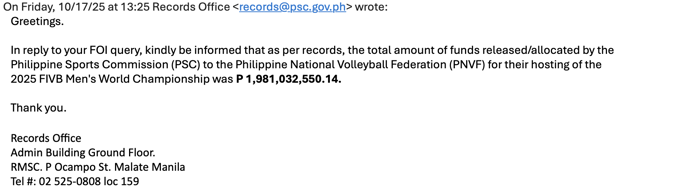
Screenshot of an email confirming the amount paid from the PSC to the PNVF for hosting the FIVB 2025 Men's World Championship.
The amount given by the PSC to the PNVF was significant as it covered all the expenses for the hosting of the event.
Other government agencies have also spent money on the championships
I then asked other government agencies in the LOC how much money they gave to the PNVF for the 2025 FIVB Men's World Championship.
The Philippine Amusement and Gaming Corporation (PAGCOR) gave 10 million pesos.
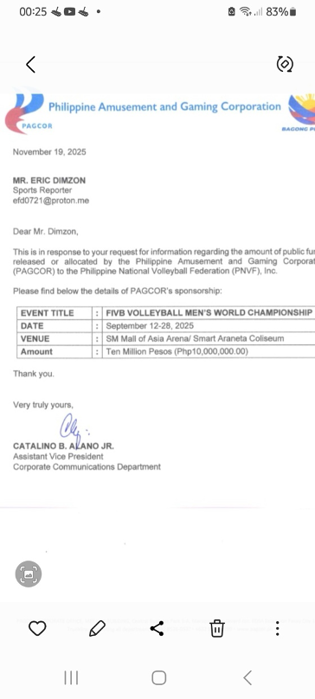
Screenshot of an email confirming the contribution from the Philippine Amusement and Gaming Corporation.
The Department of Tourism gave almost 1 million pesos to an events management company that welcomed and assisted the FIVB delegation.
The Department of Public Works and Highways (DPWH) confirmed that it did not release funds to the hosting, and neither did the Department of Foreign Affairs (DFA) nor the Department of the Interior and Local Government (DILG).
The Department of Education (DepEd), the Department of Finance (DOF), the Department of Budget and Management (DBM) and the Presidential Communications Office (PCO) chose not to respond to my inquiry.
Lastly, the Philippine Charity Sweepstakes (PCSO) neither confirmed nor denied releasing funds to PNVF.
I have filed formal complaints against those government agencies that did not respond to my inquiry, as the Republic Act No. 6713 makes it mandatory for government officials and personnel to respond to people's inquiries.
Tickets to the games were too expensive
Public support for the world championship was even more important as ticket revenues were insignificant. Attendance at the games was surprisingly low, prompting a 50 per cent price reduction. However, despite the 50 per cent ticket discount, attendance at the games remained poor and only picked up in the quarterfinals. In fact, several teams participating in the tournament complained of playing in empty venues.
The problem was that the PNVF made the mistake of initially pricing its tickets way beyond the reach of regular Filipino volleyball fans. A Filipino senator even held a Senate inquiry as to why tickets to the games were so expensive. The attendance of more than 16,000 people during the championship match between Italy and Bulgaria was the lone saving grace for the entire tournament in terms of attendance.

Many teams complained that they were playing for empty seats during the world championship. Photo: Daniel Ceng / Getty Images
The PNVF was saved from experiencing complete financial disaster by private sponsorships. The MVP group of companies, led by Philippine Long Distance Telecommunications (PLDT) spearheaded the list of big-time private sponsors with a contribution amounting to 150 million pesos. The major sponsorship of the MVP group secured streaming rights to Cignal TV, which became the exclusive broadcaster and streaming partner of the 2025 FIVB Men's World Championship.
Three other major sponsors reportedly gave a total of 120 million pesos. Rebisco, Akari and Nuvalli were listed as official partners of the tournament. Honda Philippines Incorporated was a local partner and sponsor.
Major shake-up in the volleyball federation after the world championship
At the final championship match, FIVB President Fabio Azevedo surprisingly announced that the Philippines will host yet another FIVB World Championship in 2029, namely the championship for women.
Perhaps the Philippines, through the PNVF, discovered the right formula to distinguish itself as an ideal host for big FIVB events like the world championship. Aside from the great hospitality and love for volleyball of the Filipinos, the total commitment and support of the Philippine government for the 2025 championship makes the Philippines an ideal choice as host.
In terms of revenue, the hosting was a success for the national volleyball federation, considering that the PNVF hardly spent anything for the hosting. In fact, the private sponsorships were clear revenue for the PNVF, as the public funds given by the PSC and other government agencies were enough to cover the entire cost of hosting the world championship.
This picture was shattered a few months after the world championships, when the PNVF went through a major shake-up after the hosting. The shocking and unexpected ousting of former PNVF president Tats Suzara and several other key PNVF officials might have spoiled whatever goodwill the hosting generated with the FIVB.
The newly elected PNVF president, Tony Liao, publicly stated that one of the priorities of his administration will be to "open the federation's books" and trace how the 2 billion peso government funding was used.
I requested a liquidation report from the PSC for the public funds they granted to the PNVF. The PSC failed to respond, which forced me to file a formal complaint with ARTA once again. Under Commission on Audit (COA) Circular No. 97-002, all government funds received must be liquidated within 60 days from the date of release.
It was only when ARTA started its investigation against the PSC that it divulged that the PNVF failed to liquidate 690 million pesos.
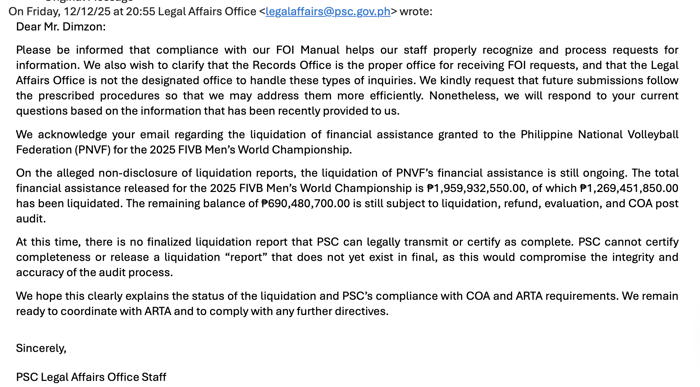
Screenshot of an email confirming that the PNVF has not liquidated all the money from the PSC.
Interestingly, the PSC asked me to issue a certification saying that the case I filed with ARTA against the PSC was now resolved, despite the existence of the unliquidated 690 million pesos of public funding.
I asked the new PNVF president for a financial report on the recently concluded hosting. He was a board member of the previous PNVF administration, but he still failed to respond and provide a financial report.
It is certainly alarming that the PNVF and even Filipino government officials appear to be unconcerned about the fact that 690 million pesos in public funds remain unaccounted for. I certainly hope for a more transparent and successful hosting in 2029.


