

Football against patriarchy: How Yuwa is changing girls’ futures in Jharkhand
As girls gather on open grounds to kick a football, Yuwa creates the possibility of play in a place where girls are expected to perform according to societal expectations. Founded in the East Indian state of Jharkhand, the non-profit uses football alongside education and life skills to support girls by offering alternatives to early marriage.
The evening sky dyes the hills in a bluish hue. In front of the hills stand two trees almost equidistant from each other. It looks as if they are guarding this part of the forest state of Jharkhand from further concretisation, while benevolently looking upon the girls scrambling to kick a football.
The girls play in t-shirts and shorts, a bunch of them sporting sleeveless, fluorescent green jackets over their tops. Such clothes might be standard fare for many teams. Here, though, society frowns upon girls 'flaunting' their legs. This is the reason many prefer to change before they return home.
But this football match does not betray the multiple concerns that weigh on the girls’ minds. In this time and place, where the expansive ground matches the openness of the sky, their entire focus is on the game. “Be organised,” hollers the team mentor. The players run in tandem, keeping an eye on the ball, their ears tuned to their coach’s instructions.
Video from an afternoon practice for girls in the Yuwa project. Video: Ankita Anand
The organisation that has created the possibility of play in a context where girls are always expected to perform according to societal expectations is called Yuwa, meaning 'youth' in Hindi.
Yuwa is a non-profit based in Jharkhand, India, which uses football, along with imparting education and life skills, to create opportunities for girls from underserved communities.
Founded in 2009, it has around 500-600 students. Girls aged 5 to 26 years are associated with the NGO, which offers them education and career options so they are not sacrificed at the altar of early marriage.
Niharika Baxla, 34, is a senior administrator and child development officer with Yuwa. Her background is in computer science, but she left her job and came back to work in her home state. Because of her interest in sports, Yuwa was the perfect workplace for her.
She recalls Yuwa’s inception: “We started with English tuition classes, having observed children who had been school-goers for 9-10 years and could not read a simple line in Hindi or English. They could not do basic calculations. But the children said they wanted to play as well. We asked what they would like to play, and football was the answer. We never had to do a recruitment drive to get children to play.”
The Yuwa school is based on empowerment
I visit Yuwa’s Ormanjhi office in a rural area near Ranchi, Jharkhand’s capital, around 9 am on a Tuesday morning.
After climbing up a set of stairs, I find a morning assembly in progress on the terrace. A colourful, hand-painted slogan on the wall reads: “We are different, but together we are a team.” To the right, there are open fields. Sunlight bravely breaks through the winter fog as a male teacher talks about how women helped him succeed in life.
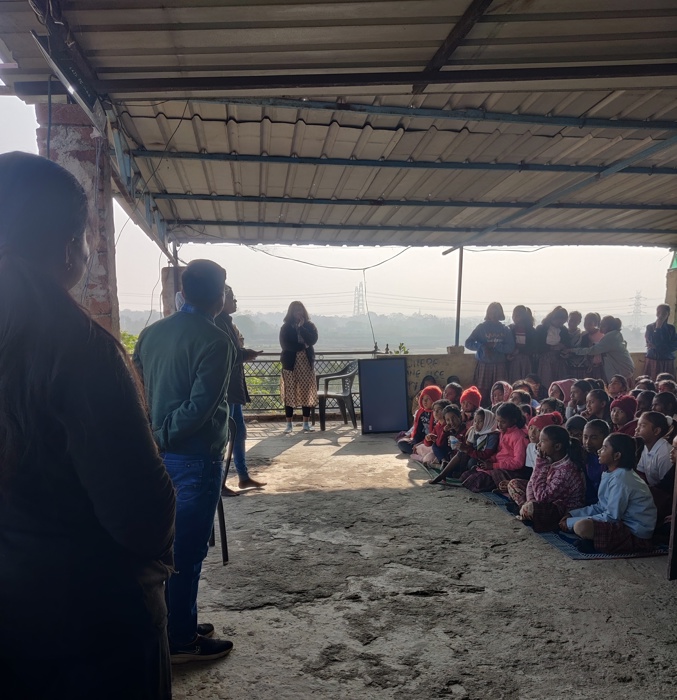
At morning assembly, the children watch a small play about women and marriage. Photo: Ankita Anand
A young woman, another teacher, talks of how she wanted to be a DJ and mentions the courses one can take to become a DJ. The talk is followed by a skit on the theme of marriage. The mother’s character steps up and says her daughter is pursuing her master’s, so marriage cannot be her focus. One of the lead actors, played by another teacher (‘Pinki Ma’am’ to the children), reveals this is her own story when her mother stood by her.
Pinki Ma’am concludes: “Today, when people say they want their daughter to become financially independent like me, I feel I have done my mother proud.”
This empowering classroom, where teachers connect to students through empathy and vulnerability, has been envisaged by Yuwa.
“There are no bad students, only bad teachers” is an adage that Yuwa firmly believes in. For them, caring, self-motivated teachers are more important than those with special degrees. The children who come to Yuwa face hardships like violence at home, power outages and financial scarcity.
If a child turns up without their homework, Yuwa believes the teacher should empathise, not punish. Yuwa also tries to get children and family members therapy when they reach out in distress.
All Yuwa participants have to attend school. They cannot come only to play. Football builds discipline, health, and team spirit. The school takes care of the rest.
The fee is 260 Indian rupees (around 3 euros) per month for grades 2 to 8. If a child’s family member goes out to earn a wage, their daily wage is likely to be higher than this fee. The fee has been kept affordable, but it exists as Yuwa observed that free education was not valued. For grades 9 and above, the fee is 560 Indian rupees (6 euros) per month.
The day of a senior player starts at 5 am
Yuwa kids run on a tight schedule. A senior player has their own practice to go to first. At 5 am, the bus leaves for the practice ground, having picked up kids from their homes. By 7.30 am, they return to their homes to finish household chores like cooking or cleaning and come to the school. After school, they return home for other tasks.
After that, they leave their houses to coach younger players, finally go back for the day, cook for the evening and finish their homework.
Children come to the centre (Yuwa) in their regular clothes. If they are consistent for three months, they are rewarded with football jerseys. Girls wear pants when they come and change into shorts before playing. Before they go home, they put on full-length trousers again to avoid comments and taunts from passersby for wearing shorts.
The young ones play in open spaces rather than a structured football academy. For most children, these grounds are close to their homes in the villages. I visited three such sites for Yuwa's 23 teams, each with its own coach.
A 14-year-old player from Dardag village said: “I joined Yuwa 5 years back and have learnt a lot. I got the chance to play in a tournament in Mumbai. I was afraid at first, but our coach taught us to play with a free mind. What I love about football is that we play together as a team.”
Another team member, who is 8 and comes from Chakla village, points to her older sister as her role model.
Yuwa started the school as an experiment, but the children worked so hard that Yuwa office bearers were inspired to continue it. A testament to the organisation’s impact was when youth with Yuwa experience got placed in colleges with full scholarships.
Otherwise, parents in the region are not keen on college. Some get their daughters admitted for the sake of it but ask them not to attend classes. They only want the women to take the exams and get the degrees, so when arranging their matches, the groom’s family can be told the woman has a college education.
Life skills and money management are part of the curriculum
Senior players in Yuwa are trained for a long time and pass an evaluation before becoming coaches paid by the NGO. A coach goes to their own community and selects children who could form a team. A competent coach, who ensures children have fun while playing, manages to develop a stable team. Children sometimes form their own team and then reach out to a coach.
Every Wednesday, Yuwa kids have a life skills workshop instead of football. Children save money to buy equipment for their team or for emergencies. They either request parents for it or save their snack money. A small team could save 5 bucks, while a bigger one could save 10 or 20. When they collect 500 Indian rupees (roughly 5 euros), it goes to one person for safekeeping. The role of money collector rotates, so each person learns money management.
Sometimes they use this money to buy a football or go for a picnic. Collectively, the children might decide to loan the money to someone who cannot pay their school fees. Another child, unsupported by their family, might be coming to play without shoes. The team helps such members.
Team spirit developed on the field extends beyond it, too. Yuwa pass-outs return to report that the habit of saving money has held them in good stead as adults.
Yuwa wants its girls to be ambitious and introduces them to women in various professions. During my visit, I, too, was asked to speak to them about how one could pursue journalism.
In the life skills workshops, participants learn about the health of adolescent girls and educational scholarships. Senior coaches or senior players facilitate these workshops. They are given session plans and a syllabus for the year. Every coordinator alters the plan according to the age group they are dealing with.
Senior players fill in applications to become these coordinators. If selected, initially, they shadow other facilitators. If they prove themselves in the interview, they are chosen to facilitate the workshops. They are also mentors for their teams, so it is crucial for senior Yuwa members to ensure that they understand the requirements of child safety, sensitivity, and emotional maturity.
Monitoring and evaluation are key to Yuwa’s functioning, which is why they have resisted expansion.
A shining example: Poonam’s story
The impact of Yuwa’s work is best seen in the lives of alumni like Poonam Kumari. At 25, she has a vision board so clear and detailed that she can coach CEOs. When the interview begins, she opens her register to the two joint pages showing a flowchart. But, in life, step 1 had not led to step 2 in such a linear fashion.
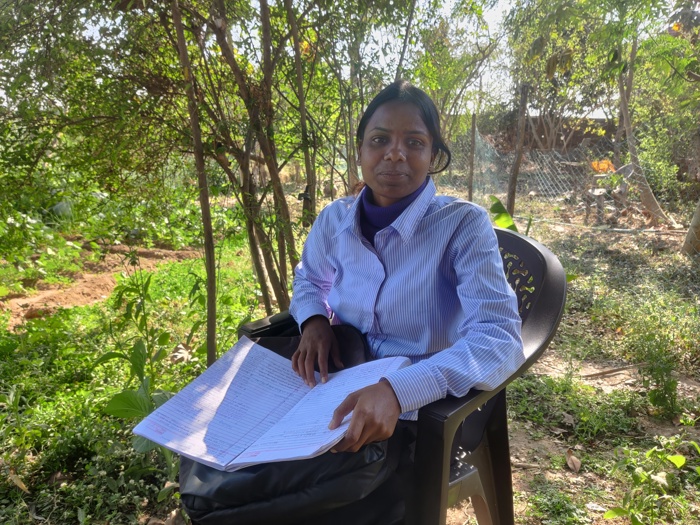
A Yuwa alumnus, Poonam Kumari, resisted her family's insistence on an early marriage and became a licensed coach. Photo: Ankita Anand
It was way back in 2008, when she was in grade 5 or 6, that Poonam Kumari saw other girls play football. That is when her interest in the game arose. Her parents in the Irba village were not supportive of this dream, though Poonam Kumari’s educated sister tried to convince them. They feared she would be trafficked if she went out to play. It was not an unfounded fear in a state where 1,319 trafficked girls were rescued in the last five years.
Despite parental apprehensions, Poonam Kumari joined Yuwa. Her practice was irregular because she had to labour on people’s fields to earn 60-70 Indian rupees (0.65-0.76 euros) per day. A Yuwa coach told her if she came consistently, played and took the responsibility of removing markers from the field, she would get 40 Indian rupees (0.43 euros) per day.
Poonam Kumari seized the opportunity and went on to play in local tournaments. But a positive shift in her family’s perspective came only after she went to Spain in 2010 to play in the under-13 team. The media covered her, and Poonam Kumari became a role model. Her sister and friends also became hooked on the game.
After Poonam Kumari's second trip to the US, her parents said she had played enough and that it was time for her to get married. Desperate, she sought Yuwa’s help and had her parents sign an agreement stating they won’t force her to marry, a promise she still reminds them of. By then, Poonam Kumari was clear she wanted to become a coach and take Yuwa’s work forward.
She spoke to Franz Gastler, Yuwa’s founder, to learn about how to become a licensed coach. Yuwa paid the bulk of the licence fee, and Poonam Kumari started coaching the under-14 team. The non-profit also sent her for an internship. After her return, she worked for four years.
To express what football means to her, Poonam Kumari said, “I can play football all day! Earlier I did not want to study. But in Yuwa, we don’t get the chance to play if we refuse to study.” For three years, Poonam also took English classes to improve her grip on the language.
Her big plan is to start a football academy for girls. But first she wishes to intern in one so she can learn the ropes.
Football runs in the DNA of the indigenous people of Jharkhand
Yuwa chose to engage children in football because of its popularity. Hockey is more expensive because every player has to buy a stick, which makes parents more likely to say no.
But football holds such attraction for kids that even the youngest in the family tag along for practice sessions with their older siblings. After a team of players shares their favourite positions on the field, I bend to ask a four-year-old, “And where do you like to play from?” The response comes: “I like to play from there.” The group bursts out laughing because the child has pointed to the entire field.
The large, open area, surrounded by trees and hills, is an ideal place for children to play with abandon. In one corner, though, some fences have cropped up - a grim reminder of how more and more communal land is under threat of occupation in a mineral-rich state.
The fact that Yuwa introduced football on popular demand is rooted in Jharkhand’s history. To know more about this, I spoke to Sunita Lakra. Sunita Lakra is from one of the 32 indigenous communities in Jharkhand and has been an activist for almost two decades. She has worked on issues like trafficking, migration, gender-based discrimination and youth empowerment in and outside Jharkhand.
Sunita Lakra says that sports run in the DNA of Jharkhand’s indigenous people: “When I was growing up, in class 3 or 4, my own family members were active in sports. Those in our family who have government jobs got them through sports. Our school had us play every Friday. Jaipal Singh Munda had played internationally and become a hero for everyone.”
The Indian politician, writer, and sportsperson Jaipal Singh Munda led the Indian hockey team in the Amsterdam Summer Olympics in 1928.
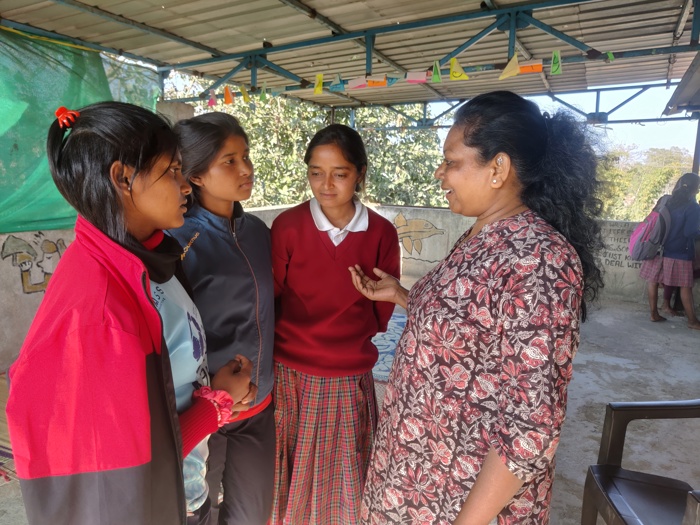
Sunita Lakra (right) explains to Yuwa students what activism entails. Photo: Ankita Anand
Unofficially, too, football and hockey have been household names in villages. There used to be ‘khassi cups’ in which the winning team was awarded a khassi (goat). Now that gets supplemented with attractive cash prizes.
Sunita Lakra describes how people filled tractors and trucks and travelled from one district to another to watch these local tournaments. It didn’t matter if the players were men or women.
“Organisations like Yuwa are a huge opportunity for girls because, unlike the boys in their families, the girls cannot inherit land or farms. Sports also prevent trafficking. After all, girls end up leaving their homes because they are not given respect, security or resources. They migrate in search of a better future and end up being exploited. If they become sportspersons, they can have a future within the state,” says Sunita Lakra.
When asked about the significance of indigenous identity in sports, Sunita Lakra explains that the original inhabitants of Jharkhand faced a lot of insecurity when the state became a separate state in 2000. There was a large influx of people from other places, as well as businesses and corporations, looking to profit from the region's rich mines, minerals, and forests. (About 40 per cent of India’s mineral resources are in Jharkhand.)
At the same time, indigenous communities, the historical conservators of these resources, got trapped in bureaucracy trying to get certificates to prove their identities so they could get their basic rights. Amidst all this, sports became a tool where they could assert their skills, talents and competences, a way to reclaim their self-respect and sense of belonging.
The challenges of getting into the official Indian teams
According to the All India Football Federation, India had 27,936 women registered as footballers in 2024. This is an extremely low figure looking at the 1.5 billion people living in India, 709 million of them women. The contrast becomes harsher when compared to a Western country like Denmark with only 6 million inhabitants, where 79,851 of them are women playing football.
In this context, what Yuwa is doing becomes even more important: supporting the young footballers’ dreams, which continue to blossom despite so many odds stacked against them. It is this grit that helped the Indian women’s team qualify for the 2026 Asian Cup and aim for the FIFA World Cup.
However, in the past, such dreams had to be deferred because of internal challenges, such as the 2022 suspension of the national football federation by FIFA due to governance issues, limited resources, and subpar playing grounds. There is also gender-based discrimination leading to a lack of local leagues and academies for girls, though the women’s team FIFA ranking has been higher than that of men’s.
Organisations like Yuwa help fill this gap by providing a support structure for players, guiding and mentoring them so they can compete in the state's official team selection trials.
Niharika Baxla from Yuwa explains that the organisation does not have links to the football federation, but well-wishers let them know about team selection trials. If official selection processes were more transparent, the kids would stand a better chance at selection, but sometimes authorities reach out to Yuwa when they need a player for the official team at the last moment, for example, if an already selected player is injured.
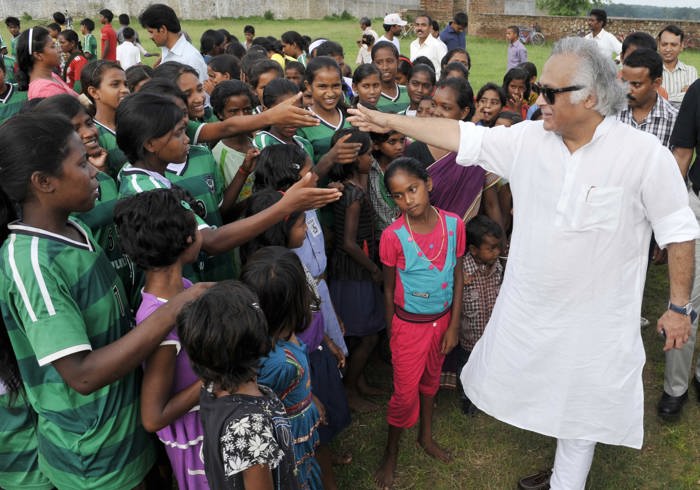
In 2013, a team from Yuwa performed well in an international tournament in Spain, and was later paid a visit from the then rural development minister Jairam Ramesh. Photo: Diwakar Prasad / Getty Images
The government’s sports department has its own academies, and it is a matter of great prestige for the government that the official team should consist of children from those academies instead of private teams like Yuwa’s, though they are allowed to participate in the trials like other players.
Nihraika Baxla beams: “In the past few years, five of our kids have been able to participate in the nationals.” Getting the official stamp means players can have access to financial and employment support from the government.
The selection process has opened up more after company sponsorship of players came into play. Since businesses are putting in the money, they want to select players based on their performance, not due to any external or political influences or pressures.
Getting access to playing fields is an ongoing challenge
A practical problem Yuwa kids face is not having access to an astro-turf, the turf where all official matches are held. As of now, they play on open grounds, different in size from the astro turfs. Many are used to playing barefoot on their nearby, smaller fields. Some of them are uneven, ragged terrains, dug up at some places and strewn with broken bottles at others.
But if a player does get selected to represent India, they have to wear shoes, which feel hotter when playing on astro-turfs. This sudden change in footing shakes them up. They feel lost as to their positioning, and it becomes hard for them to win the match. Teams get discouraged that they could not practise earlier on such turfs, though they measure up to other players when it comes to skills or talent.
Yuwa staff did not have much luck getting permission to practise on the turf built in the state capital of Ranchi. Khel Gaon, the sports village in the city, has many facilities. But Yuwa kids cannot use them.
“We are willing to pay, which would have helped in the maintenance of the facility,” says Niharika Baxla. But the organisation adds they won’t have been able to take children that far for regular practice. Yuwa is trying to get their supporters to sponsor a turf so players can have enough practice before they contest matches.
Common, community grounds help. People in Ormanjhi are aware of the importance of these because of Yuwa and its emphasis on football and many have been protecting their grounds. Now that families in 12-15 villages of the Ormanjhi district have come to respect Yuwa’s role in their children’s lives, they, too, offer their farms.
But there is always misogyny to contend with. Some people deliberately dig up the grounds or leave broken beer bottles where they see girls playing. Boys take note of the girls’ schedule and appear to be playing cricket or other games at the same time and place. They play aggressively, so the girls get injured and leave. Yet, there are supportive parents who fight on the girls’ behalf. They tell the ad hoc players to fix a time so that the regular team of girls is not displaced.
Some younger boys are still untouched by toxic masculinity. Their intention is to help, not disrupt. They run to fetch the ball and try to prove how quick and disciplined they can be. Their appeal is: “We can wear the pants and shoes required to play the game. If this team is for girls, tell us who we can talk to for a boys’ team. Just give us a coach bhaiyya (older brother) or didi (older sister).”
The boys might get pampered at home because of their gender, but they do not get any mentorship, which they crave for when they see the girls getting trained.
It is not like Yuwa is closed to boys. But earlier, when boys came, they were either not serious or didn’t give the girls a chance to play. Niharika Baxla says, “Boys can come if they bring four girls. After we made this rule, only committed people started coming. Currently, there are about 25 boys amongst approximately 500 girls.”
Yuwa’s head coach, Paras Karmali, only a boy when he joined Yuwa, was selected to coach the official state team (which included two Yuwa girls), leading it to victory in the sub-junior girls’ national championship in August 2025.
Sport is not enough, education is important too
When it comes to studies, any student who puts in the effort gets ahead. But in sports, amongst a bunch of kids acing the game, only a few will be selected for the official teams. There are people who played at the national level for four years but could not go any further. If one’s performance dips a bit, they can be out of the team and back to square one. Even if everything goes right, one cannot be on the team forever.
At the time of reporting this story, a local newspaper published the story of a sportswoman forced to work as a domestic worker. That is why Yuwa insists on all-round development so kids are not left hanging with only one skill in life.
Niharika Baxla reminisces: “We saw kids who were somewhat old but could not read. We realised sports were not going to be enough.”
Yuwa encourages older children to work at their office and earn while they are studying. About 14-25 of them end up earning 4,000-20,000 Indian rupees (43-216 euros) per month. Such administrative and teaching work, which can be done side by side with studies, is much better than working in a factory in Jharkhand where one has to toil for 8 hours to earn a measly 6,000-8,000 Indian rupees (65-86 euros) for the month.
With work experience, young people from Yuwa stand out at the time of college admissions and scholarships.
Niharika Baxla lists two students who recently went to Spain to study business, four to Bangladesh, and others to the US and reputed institutions like Ashoka University and Azim Premji University in India.
Azim Premji University sends its staff to Yuwa for the children’s counselling so the kids can learn more about admissions. Without full scholarships, some of these places would have cost 10-12 lakh Indian rupees (nearly 11,000-13,000 euros) per year.
Some Yuwa pass-outs became faculty at the two universities, appreciated for their discipline and rigour. Their sports experience makes them valuable for the college sports teams. Additionally, they can become sports coordinators at these institutes, which comes with the added bonus of campus accommodation.
In Ormanjhi, the locality where Yuwa is situated, many people come from the Mahto community. Farming is their mainstay. Sports and studies are not encouraged. But when one Yuwa kid went to Harvard, people saw the impact. Yuwa alumni have gone to both Indian and foreign institutions on scholarships, which inspires faith in families.
Left to themselves, parents hesitate to send their kids to college. Some young people managed to get admission somehow and sit for the exams. but couldn’t attend classes. After the Yuwa experience, they are earning 80,000-90,000 Indian rupees (865-972 euros) a month. The intergenerational financial trauma of the families is getting broken in a state which is amongst the poorest in India.
The first batch of Yuwa saw 45 enrollments. At the time, Yuwa members used to spend 3-4 hours explaining to the parents the concept of the school, arguing that the children were hardly learning in their regular schools. (A report identified around 65,000 children in the state who were not enrolled in schools.)
The following year, the number of students in Yuwa doubled.
Niharika Baxla smiles: “Now parents tell us, ‘Every child has the right to education. How can you deny admission to my child?’ We say, “But where will they sit?! We are running this school on rented property.”
The organisation is particular about keeping the class size small. Every student must get individual attention from the teacher. What Yuwa is doing in terms of confidence-building and motivating the children is something even expensive schools aren’t able to do. Because of sports Yuwa kids are more fluent on stage than private school kids.
Sport is changing the narrative about women being a burden
But the organisation has to ensure that only those who cannot access other schools come here, which means children whose entire family’s income is 10,000 Indian rupees (around 110 euros) per month.
Earlier, the parents were criticised by members of their community. They were accused of selling their children to outsiders. Now the critics are regretting they pushed their girls into early marriages, and the latest National Family Health Survey found that 32 per cent of young women in Jharkhand were married prematurely, before they turned 18.
A woman who didn’t listen to Yuwa’s appeals and got 3-4 of her daughters married early approached them later, lamenting about her daughter’s ill health due to repeated miscarriages and asking for a job for her.
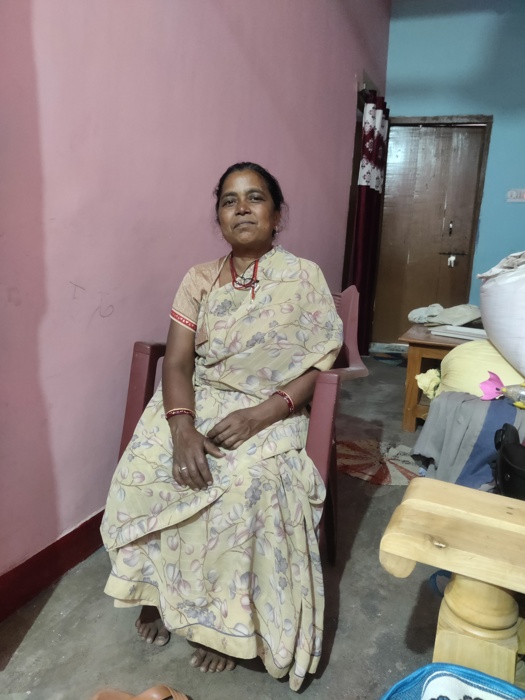
Sita Devi supports her granddaughter's passion for football and getting an education. Photo: Ankita Anand
Amongst families who dared to flout societal norms and support their girls, Sita Devi is one. She is grandmother to Yuwa’s Sangeeta Kumari and talks about what she earlier felt about her granddaughter's passion for football: “We women did not know anything when we got married. I am not educated. I used to be afraid that Sangeeta could get injured.”
Sangeeta Kumari's maternal uncle is quick to add: “Our kids won’t get ahead in life if we do not support them. We should not bother about what society says.”
The real impact that sports have had on women’s lives can be understood by comparing it to what is happening with a lot of men in Jharkhand. Men lag behind because they do not realise how patriarchy is keeping them in chains.
A large section of men in the communities grow up believing they do not have to study because they will inherit land. After Jharkhand split from the state of Bihar and became a separate state, real estate prices soared.
Men have been selling land at lucrative prices and using the money to drink, smoke and buy expensive bikes and cars. Left with no skills or education, they resent women who are educated, earning and choosing to marry men with similar qualifications. On top of all this, the coming generations of men won’t have ancestral land, as it would have been sold off.
“Parents are willing to send their son to a private school by selling their land or taking loans, sacrificing their own basic needs. Even then the son could hit his parents, go on a hunger strike or threaten suicide if he is not given the fancy bike he has set his heart on. You will see young men with iPhones whose parents are daily wage labourers,” Nihraika Baxla shares.
Yuwa found that it is the same kind of parents who were reluctant to pay the 260 Indian rupees (under 3 euros) per month fee for their daughters to attend their school.
Girls face the shackles of patriarchy much more blatantly. They know it is something to escape and thus grab whatever opportunities come their way. The same women who were seen as a burden are now the breadwinners for their parents after leaving Yuwa.
The men were spoiled so much that they aren’t in a position to shoulder responsibilities. This is huge because in this way, sports are changing the entire narrative around women being the family’s liabilities and men being assets.


