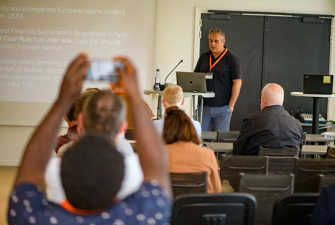

Experts challenge the European Sport Model: "No one knows what it really is"
As the EU drafts a new vision for sport, voices at the MOVE Congress in Copenhagen warned that policy ideals and everyday participation are worlds apart.
Many people are aware of the European Sport Model (ESM) – a broad organisational pyramid in which elite sport sits at the top, values are cited, governing bodies oversee the management of each discipline and revenue from professional sport is redistributed to the grassroots. But how much of this structure reflects reality? And is it really the most effective model for increasing participation?
ISCA President Mogens Kirkeby emphasised the contrast between the simplified narrative of the ESM and the reality – a diverse landscape of varied grassroots initiatives and organisations, many of which are not linked to governing bodies and rely on volunteerism.
“The traditional model is like a church with elite sport at the top of the spire, where the best professional teams and athletes stand,” he said. “But this is not the only model.”
Dr Layne Vandenberg, senior researcher at Play the Game, which is partnered with ISCA on a project to develop a new sports model for Europe (Real European Sports Model) detailed ongoing research into the effectiveness of the ESM, which asks to what extent it reflects reality and whether other models might better reflect the reality.
“While many are aware of the ESM as an approach to organising, governing and financing sport in Europe, no one is fully aware what it actually is,” she said.
“Policy documents from across Europe over the past half-century show little consistency when it comes to sport. You have every right to ask what the ESM means.”
The current ESM, she said, is characterised by abstract ideals like autonomy, open competition, solidarity, and equality, which are far better suited to political lobbying than concrete practice.
Gaps in the model – such as health, well-being and leisure activities that are not part of organised sport - mean that the ESM does not reflect the full reality of participation. Focusing on the extent of participation, she said, would offer a far more realistic picture of health-enhancing activity across the continent.
The EU is working on a new vision for sport in Europe
Following her presentation, a high-level panel consisting of Play the Game founder Jens Sejer Andersen, head of the European Commission’s Sport Unit Guazzugli Marini, and former head Jaime Andreu gave insights in the state of play in the European institutions. Are they able to adapt to today’s realities?
Giorgio Guazzugli Marini explained that in 2009, the EU was given legal competence to address European sporting issues directly - meaning that national authorities were able to engage in policymaking on sport within the EU framework for the first time.
He highlighted the Erasmus+ scheme, which allocates substantial regular funding for grassroots sport, as a positive development, and described the proposal for the next generation of Erasmus, in which sport is featured prominently, as a “major achievement.”
He also referred to an ongoing consultation process that will result in a new communication by the end of next year that “will offer a new vision for sport in Europe.”
“The European Commission is taking stock of the current situation, mapping the reality and giving greater recognition to how sport is considered in Europe,” he said.
“Things evolve, and the EU must be able to keep pace. The European Sport Model does not need to be rigid; it can reflect the fact that things are evolving.”

Jens Sejer Andersen, founder and senior advisor at Play the Game, believes that the most important sports political debates in Europe are currently taking place in the Council of Europe. Photo: ISCA
The Council of Europe's charter on sport can be a tool for driving change
Jens Sejer Andersen, who has also coordinated Erasmus+ projects for the European Commission’s sports initiatives, said that the Council of Europe is perhaps the forum where the most vibrant sport-political debate is currently taking place.
However, he added that he was encouraged by the EU’s decision to launch an open and wide consultation process that will examine the future of sport governance.
He noted that the Council of Europe has issued several legally binding conventions which Member States may choose to adopt, covering areas such as anti-doping and spectator unrest, as well as the Macolin Convention on match-fixing, which has still not been fully ratified across the EU.
He went on to highlight the principles enshrined in the Council of Europe’s European Sports Charter (ESC) as a potential tool for driving change.
“The ESC unites all Member States around certain principles,” he said. “It contains a number of provisions that can be translated into recommendations. Ministries often take these recommendations and adjust their policies accordingly.”
Jaime Andreau pointed out that Europe’s organisational sports structure has been evolving for many years, and the EU regularly maps the impact of the internal market on sport. As examples of how the model has adapted to new realities, he cited how the public-TV model was transformed by commercial broadcasting and the upheaval of the football transfer system in the wake of the Bosman ruling.
He also noted that scandals and legal rulings can often shape policy. “Sport suffers when democracy suffers,” he said.
The Real European Sports Model is an ISCA-led initiative aiming to create a new framework for sport in Europe that better reflects grassroots and recreational activity, rather than focusing solely on competitive structures. It receives funding from the EU’s Erasmus+ programme.
This article was first published on www.isca.org